
Big Five Personality Traits Explained and How They Shape Human Behavior
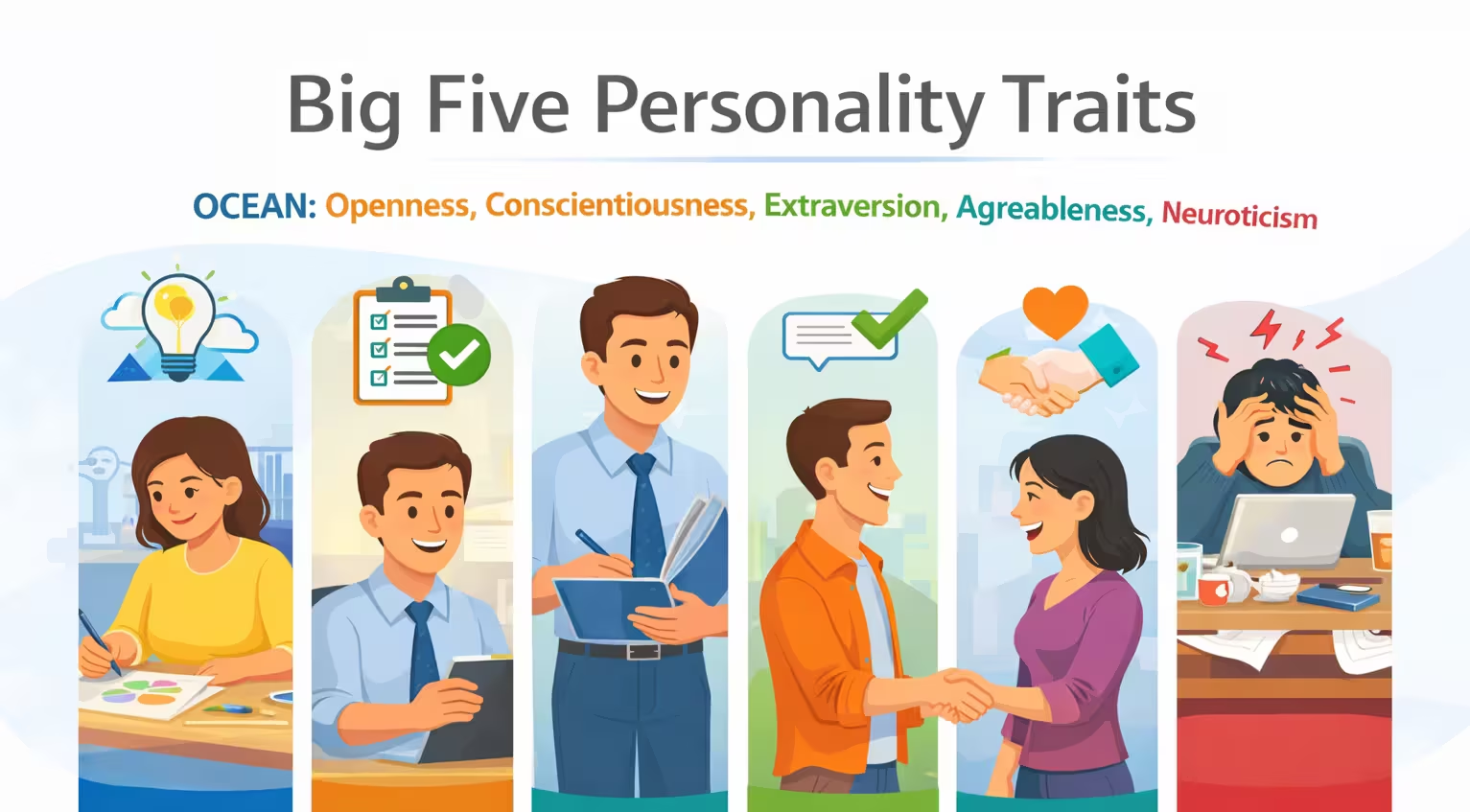
The Big Five Personality Traits are central to modern personality science and help us understand ourselves better. This model, also known as the Five Factor Model of Personality or OCEAN, breaks down human personality into five main dimensions that explain how people think, feel, and act. Years of research show these five traits are stable, can be measured on a scale, and can predict important life outcomes like job performance and well-being. While many online guides only cover the basics, this article will go further. It will explain how the traits are measured, how they affect areas like work and relationships, how they change over time, common uses, and more advanced topics such as facets and cultural differences.
What Is the Big Five Personality Traits Model?
The Big Five Personality Traits framework is a scientifically validated model that conceptualizes personality as five major continuous traits, rather than as discrete categories such as “introvert” or “type A.” This model originated from factor analysis of language descriptors, which involved statistically grouping thousands of terms used to describe individuals and revealed five stable dimensions of personality. These dimensions offer a comprehensive representation of personality variation among individuals. The Five Factor Model of Personality is now the most widely utilized framework in both personality research and practical applications.
The five traits are:
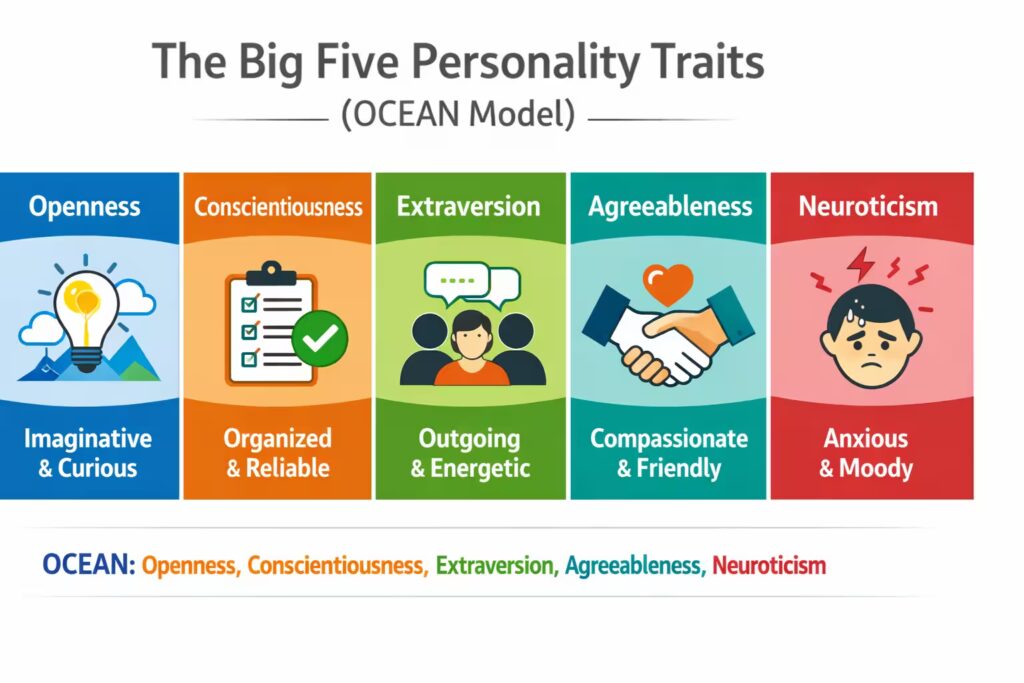
- Openness to Experience (inventive vs. consistent)
- Conscientiousness (organized vs. careless)
- Extraversion (outgoing vs. reserved)
- Agreeableness (compassionate vs. challenging)
- Neuroticism / Emotional Stability (sensitive vs. resilient)
A useful memory acronym is OCEAN (Openness, Conscientiousness, Extraversion, Agreeableness, Neuroticism) or CANOE (Conscientiousness, Agreeableness, Neuroticism, Openness, Extraversion).
In‑Depth Look at Each Trait
Openness to Experience
Openness reflects a willingness to engage with new ideas, experiences, and imagination. Individuals high in this dimension tend to be curious, creative, and comfortable with abstract thinking. They enjoy exploring art, culture, and innovative concepts. In contrast, those lower on openness prefer routine, tradition, and practicality.
Key Features of Openness
- High: imaginative, curious, artistic, broad interests
- Low: conventional, practical, prefers familiarity
Real‑world example: High openness individuals may thrive in roles requiring innovation (e.g., product design, research), while low openness individuals may excel in structured, rule‑based environments.
Conscientiousness
Conscientiousness captures self‑discipline, goal focus, organization, and reliability. People high on this spectrum are diligent planners, dependable, and strong at delaying gratification for long‑term gains. Those lower in conscientiousness tend toward spontaneity, flexibility, and sometimes procrastination. Fear of Big Things might stem from low Conscientiousness, which affects how individuals approach challenges and large-scale decisions.
Key Features of Conscientiousness
- High: organized, responsible, achievement‑oriented
- Low: impulsive, relaxed about deadlines, unfocused
Conscientiousness is one of the strongest predictors of academic success, job performance, and healthy habits.
Extraversion
Extraversion describes the degree of social engagement and energetic interaction with the world. Highly extraverted people are outgoing, talkative, and energized by social settings. Those lower on extraversion (often called introverts) prefer solitude or smaller group interactions.
Key Features of Extraversion
- High: sociable, enthusiastic, assertive
- Low: reserved, reflective, prefers calm environments
Extraversion influences how people lead teams, communicate, and manage stress in social contexts.
Agreeableness
Agreeableness reflects compassion, cooperation, and preference for harmonious relationships. High agreeableness individuals are empathetic, friendly, and trusting. Low agreeableness is associated with competitiveness, skepticism, and prioritizing self‑interest.
Key Features of Agreeableness
- High: empathetic, helpful, cooperative
- Low: direct, competitive, critical
Agreeableness affects teamwork, conflict resolution, and customer‑facing roles.
Neuroticism (Emotional Stability)
Neuroticism measures the tendency toward emotional reactivity, stress, and mood fluctuations. Higher scores indicate sensitivity to stress and negative emotions. Lower scores indicate calmness, resilience, and emotional steadiness. Fear of Heights can be related to Neuroticism, one of the Big Five Personality Traits, which plays a role in how individuals react to anxiety-inducing situations.
Key Features of Neuroticism
- High: anxious, self‑conscious, easily upset
- Low: calm, resilient, even‑tempered
High neuroticism can affect mental health risk, stress responses, and coping strategies.
How the Big Five Personality Traits Are Measured
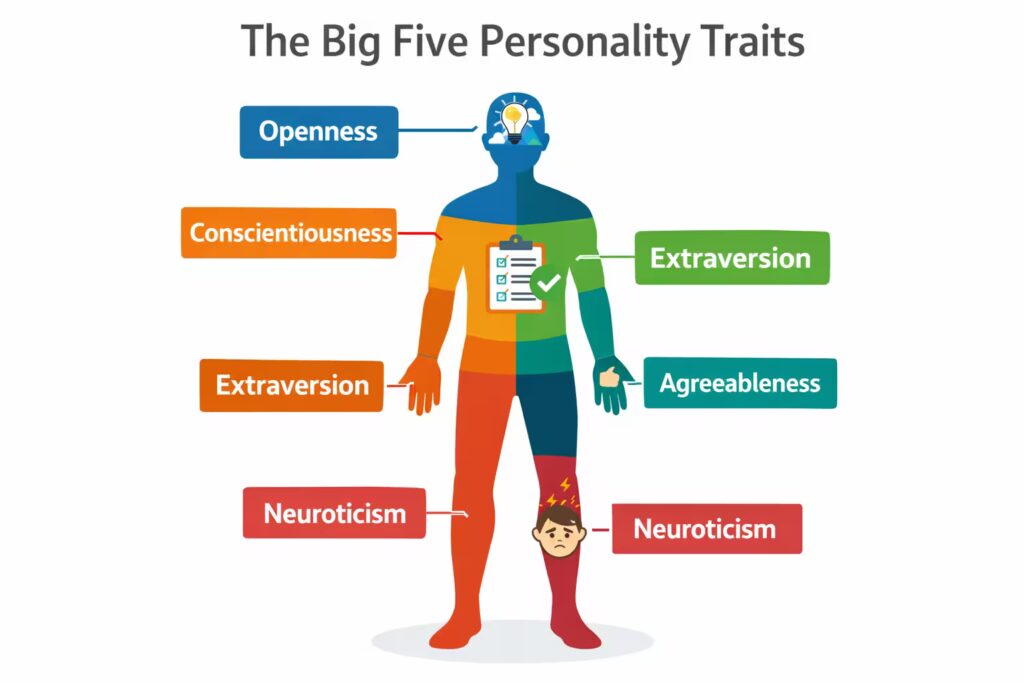
Measurement of the Big Five Personality Traits uses standardized inventories where individuals self‑report their degree of agreement with specific statements. Well‑known tools include:
- NEO Personality Inventory (NEO‑PI‑R / NEO‑PI‑3): A detailed assessment with facet scores beneath each major dimension.
- Big Five Inventory (BFI): A widely used questionnaire focusing on succinct trait scores.
- International Personality Item Pool (IPIP): Free public measure with long and short forms.
These tests place individuals on continuums for each trait—no one is “purely extraverted” or “purely introverted.” Most people fall somewhere in between.
History and Scientific Roots of the Big Five Personality Traits
The Big Five Personality Traits model has a rich history rooted in decades of psychological research. The origins of this theory can be traced back to the early 20th century when psychologists sought to categorize the wide range of human personality traits. Early trait theorists, such as Gordon Allport and Raymond Cattell, attempted to understand personality by focusing on various descriptors used to describe individuals. Their work laid the groundwork for later research in psychological traits and personality psychology.
In the 1940s and 1950s, psychologists began using factor analysis—a statistical method that identifies patterns in large sets of data—to simplify the numerous descriptors into broader categories. This led to the identification of the Five Factor Model (FFM), now commonly known as the Big Five Personality Traits or the OCEAN model (Openness, Conscientiousness, Extraversion, Agreeableness, and Neuroticism). Researchers such as Lewis Goldberg, Paul Costa, and Robert McCrae further refined the model in the 1980s and 1990s, focusing on the five major factors and their role in predicting behavioral health patterns and life outcomes.
The Big Five theory has become the gold standard in personality psychology, largely because it is both empirically supported and cross-culturally valid. Over the years, the model has expanded beyond psychology into fields such as organizational behavior, education, and even health psychology, making it a foundational tool for understanding human behavior across various contexts.
Why the Big Five Matter: Real‑World Applications
Career and Workplace Success
Personality traits predict job performance, leadership potential, teamwork, and job satisfaction.
- Conscientiousness consistently correlates with better performance and reliability.
- Extraversion supports leadership emergence and customer‑oriented roles.
- Agreeableness aids teamwork but may trade off assertiveness when needed.
- Neuroticism often predicts stress vulnerability, which can affect performance under pressure.
- Openness supports innovation and adaptability.
Mental Health and Wellbeing
Personality influences emotional health and life satisfaction. High neuroticism often correlates with anxiety and depression risk, while high conscientiousness and agreeableness are linked to more stable wellbeing. Recognizing one’s trait profile can help tailor therapy and coping strategies.
Relationships and Social Dynamics
Understanding your own and others’ personality profiles can improve communication, reduce conflict, and strengthen partnerships. Extraverts may seek energetic social engagement, while introverts may need quiet reflection time. Agreeableness fosters empathy, but low agreeableness might signal boundary setting.
Education and Learning Styles
Traits like openness and conscientiousness can shape how people approach learning. Curious, open students embrace new subjects, while structured learners thrive with clear goals. Recognizing these traits can help educators tailor instruction.
Health and Lifestyle Choices
Personality influences habits—diet, exercise, sleep, and substance use. For example, conscientious people are more likely to maintain healthy routines and preventive care, reducing risk for chronic illnesses. Personality can even correlate with long‑term health outcomes like dementia risk.
Advanced Topics: Facets and Granularity
Each major trait contains facets—specific sub‑components that provide richer insight. For instance, within extraversion are aspects like assertiveness and enthusiasm. Understanding facets helps explain why two people high in the same trait may behave differently.
Personality Across the Lifespan
Traits are not fixed at birth—they shift subtly across the lifespan.
- Conscientiousness and agreeableness tend to increase with age.
- Openness and extraversion may decline slightly as people prioritize routines.
- Neuroticism often diminishes as emotional regulation improves with maturity.
These patterns reflect both biological development and environmental adaptation.
Cultural and Diversity Considerations
While the Big Five Personality Traits have been validated across many cultures, there are nuances in how traits manifest across societies. Language, cultural norms, and context influence expression and interpretation of traits.
Academic Debates and Controversies
Universality vs. Cultural Specificity
Some critics argue that the model reflects Western linguistic biases and may not capture culture‑specific personality dimensions. Researchers continue to refine cross‑cultural measurement tools.
Trait Stability vs. Situationism
Debate exists over how much personality traits predict behavior versus situational factors. Some say traits explain broad patterns, while others argue context matters more in specific behaviors.
Trait vs. Other Personality Models
Alternative models (e.g., HEXACO, Myers‑Briggs Type Indicator) offer different dimensions or typologies. The Big Five Personality Dimensions remains dominant in research due to empirical robustness and predictive validity.
Practical Tips for Interpreting Your Trait Scores
- Look at your profile holistically: High scores in one trait can interact with others (e.g., high extraversion + high agreeableness suggests sociable cooperativeness).
- Use profiles for growth: Understanding areas like conscientiousness can help set habits; low extraversion doesn’t imply a flaw—just a different energy preference.
- Context matters: Job or relationship demands influence whether a trait is advantageous.
Common Misunderstandings
- It’s not a typing system: Unlike typologies (e.g., “introvert” vs “extrovert”), the model views traits as spectrums.
- No trait is “good” or “bad”: Each can confer strengths and challenges depending on context.
- Personality isn’t destiny: Environment, experiences, and choices interact with traits.
Big Five Personality Traits and Life Outcomes
Leadership and Management
Leaders often show balanced profiles—moderate extraversion for communication, high conscientiousness for planning, and moderate agreeableness for social influence.
Team Composition and Performance
Teams with diversity in personality traits often perform better because they bring complementary strengths (e.g., high openness fosters innovation, high conscientiousness ensures follow‑through).
Academic Achievement
High conscientiousness predicts academic diligence and task completion. Openness supports theoretical and creative learning.
Examples of Big Five Trait Profiles
Below are sample profiles to illustrate how combinations shape personality (not exhaustive):
The Innovator
- High openness
- Moderate extraversion
- Moderate conscientiousness
- High agreeableness
- Low neuroticism
Traits: Creative, adaptable, sociable, emotionally resilient.
The Organizer
- Moderate openness
- Low extraversion
- High conscientiousness
- Moderate agreeableness
- Low neuroticism
Traits: Detail‑oriented, steady, reliable, thoughtful.
The Diplomat
- Moderate openness
- Moderate extraversion
- Moderate conscientiousness
- High agreeableness
- Moderate neuroticism
Traits: Cooperative, diplomatic, supportive, sensitive.
How to Use Big Five Insights in Daily Life
Conclusion
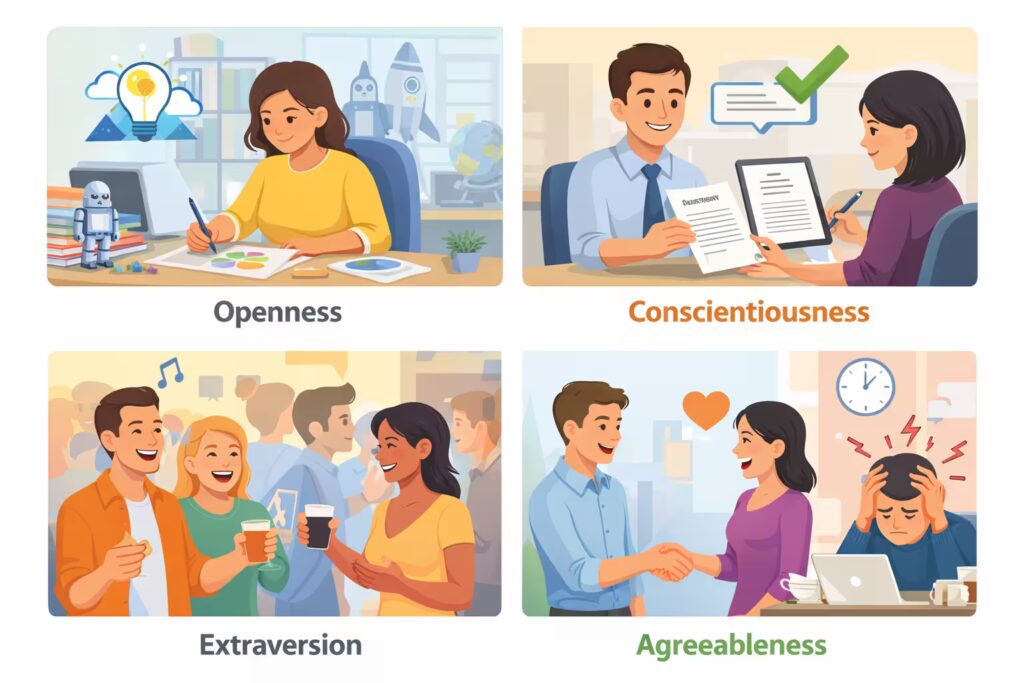
The Big Five Personality Traits model remains the most empirically supported and versatile framework for understanding personality differences. By examining traits as continuums rather than categories, you gain nuanced insight into behavior, motivation, and life outcomes. Whether for career growth, better relationships, personal awareness, or academic understanding, OCEAN provides a powerful lens to view human diversity. This guide goes beyond definitions—offering practical applications, advanced perspectives, and real‑world examples to help you truly understand and use your personality profile.