

Existential Crisis Meaning: Your Complete Guide to Understanding, Symptoms, and How to Cope
Existential crisis meaning refers to a period of deep self-questioning where a person begins to struggle with the meaning, purpose, or direction of life. During an existential crisis, someone may reflect on their identity, personal values, freedom, choices, mortality, and the reason for their existence. It is often triggered by major life changes, emotional stress, or personal growth, and it can be a normal psychological response when a person is trying to better understand themselves and their place in the world.
What is Existential Crisis Meaning?
An existential crisis is a deeply personal period when you start to question the very foundation of your life—your purpose, identity, and what it all means. It’s not just stress about daily problems, but a moment when the usual answers you rely on no longer feel satisfying. At its core, it’s a crisis about meaning and existence itself.
Unlike ordinary stress or anxiety, an existential crisis makes your whole worldview feel unstable. It’s a psychological and emotional confrontation with life’s big questions and often touches on things like mortality, freedom, responsibility, and belonging.
In simple terms, an existential crisis happens when you stop taking life for granted and start asking:
Why am I here? What is my purpose? Does anything really matter?
The Roots in Philosophy
preloadedUnderstanding why existential crises happen becomes clearer when we look at existentialism, a philosophical movement that focuses on human freedom, choice, and individual meaning. Existentialist thinkers like Jean-Paul Sartre and Søren Kierkegaard argued that life doesn’t come pre-loaded with meaning — you create meaning through your choices.

This philosophical angle adds depth: an existential crisis isn’t irrational; it’s a natural confrontation with life’s uncertainty and freedom. It’s the human mind trying to make sense of its own existence.
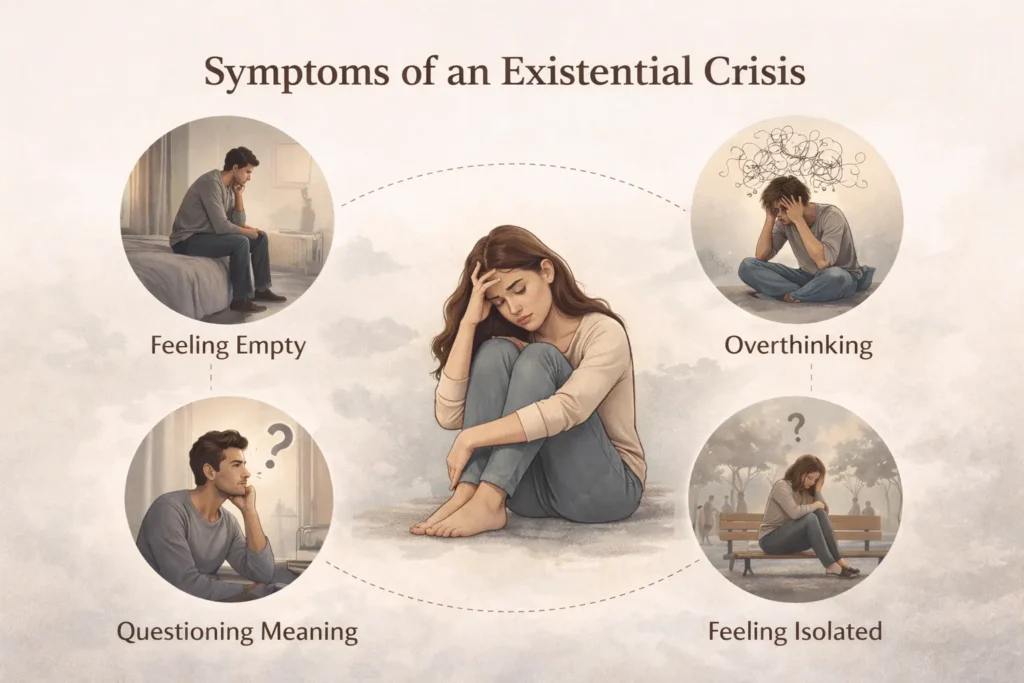
Symptoms: How to Know You’re Experiencing an Existential Crisis
An existential crisis can look very different from person to person, but some common patterns include:
- Feeling that life lacks meaning or that your efforts are pointless.
- Experiencing sudden emptiness or a loss of direction.
- Questioning your identity or your role in the world.
- Withdrawal from things you used to enjoy.
- Thinking often about life, death, and purpose more than usual.
- Feeling disconnected from others and from life itself.
These signs are not always clinical symptoms of depression or anxiety — but they can overlap and feel very intense. An existential crisis often appears when you’re stuck between how life is and how you think life should be.
Why Existential Crises Happen (Common Triggers)
Existential crises can be triggered by major life changes, but sometimes they emerge without a clear event. Some common triggers include:
- Losing a job or facing career uncertainty.
- Death or loss of someone close.
- Big milestones like getting married or having a child.
- Personal achievements that raise the question: “Is this what I truly wanted?”
- Feeling aging, regret, or unfulfilled dreams.
Sometimes even positive events like marriage or success can spark unexpected reflection—because they force you to rethink your values and purpose.
Articles you also want to read:
- Fear of Big Things: Understanding Megalophobia — Causes, Symptoms, & Coping
- Phobia of the Ocean: Understanding Thalassophobia
- Executive Dysfunction ADHD — What It Is, How It Feels, and How to Move Forward
How an Existential Crisis Differs from Depression
Many people confuse existential crises with clinical depression or anxiety. While they can share common feelings like sadness or emptiness, they are not the same thing. In an existential crisis, the core issue is questioning meaning and identity—not necessarily a chemical imbalance or diagnosable mood disorder.
If your emotional state is severe, persistent, or significantly impacts your daily functioning, then consulting a mental health professional is important.
Examples of Existential Crisis Moments
Here are relatable scenarios that capture what many people go through:
- A young professional who achieves their dream job and suddenly wonders if that success actually matters.
- A parent who, after raising children, feels a deep sense of emptiness or loss of purpose.
- Someone who survives a life-threatening illness and begins to question what truly matters in life.
These are not extreme or unusual reactions—they are part of what it means to be human.
How to Deal With an Existential Crisis
1. Reflect Without Judgment
Allow thoughts about meaning and purpose to arise without shaming yourself. Curiosity is more helpful than fear.
2. Connect With Others
Talking to friends, support groups, or a therapist brings perspective and helps combat isolation.
3. Focus on What You Can Control
Choose small actions aligned with your values—even tiny changes build a sense of meaning.
4. Practice Mindfulness and Journaling
Writing out your thoughts clarifies what matters to you and reduces mental noise.
5. Explore Purpose Through Action
Meaning doesn’t always come from abstract thinking — sometimes it comes from contributing to something greater than yourself.
6. Consider Professional Support
Therapy styles like existential or cognitive-behavioral therapy can help guide you through deep reflections into meaningful change.

Is an Existential Crisis a Bad Thing or a Turning Point?
An existential crisis is often labeled as something negative, but in reality, it can be a powerful turning point. This phase usually appears when old beliefs no longer fit who you are becoming. Instead of signaling failure, it often marks emotional growth and self-awareness.
Many people who experience an existential crisis later report making healthier life choices, building stronger relationships, or changing careers to align with their values. The discomfort exists because growth demands honesty, and honesty can be unsettling.
When seen through this lens, an existential crisis is not a breakdown of life’s meaning—it is the rebuilding of it on more authentic foundations.
Existential Crisis at Different Life Stages
Existential crises do not look the same at every age. The questions evolve as responsibilities, expectations, and life experiences change.
In young adulthood, the crisis often revolves around identity, career direction, and belonging. People ask whether they are on the “right path” or simply following societal pressure.
During midlife, existential questioning may focus on unfulfilled dreams, time, and personal legacy. Thoughts like “Is this all there is?” become common as people reassess decades of choices.
Later in life, existential concerns tend to center around mortality, contribution, and meaning beyond productivity. These reflections are deeply human and reflect a natural psychological transition rather than a mental weakness.
Understanding the life stage helps normalize the experience and reduces unnecessary self-judgment.
Cultural Meaning: Crisis Existencial Significado Explained
The term “crisis existencial significado” highlights how existential crises are not limited to one culture or language. Across societies, humans struggle with the same fundamental questions about purpose, freedom, and existence.
In many cultures, existential crises are shaped by social expectations, family roles, and spiritual beliefs. Some societies interpret these crises as spiritual awakenings, while others frame them as psychological struggles.
Recognizing this broader cultural meaning helps individuals feel less isolated. It shows that existential questioning is a shared human experience rather than a personal failure.
How Existential Crisis Affects Relationships and Daily Life
An existential crisis does not stay confined to internal thoughts—it often spills into daily interactions and relationships. People may become emotionally distant, more irritable, or less interested in social activities they once enjoyed.
Relationships can feel strained when others do not understand the depth of internal questioning. Conversations may feel shallow, and emotional connection may feel harder to maintain.
However, this phase can also strengthen relationships when individuals communicate openly about their thoughts and needs. Honest dialogue often creates deeper emotional intimacy and understanding.
When to Seek Professional Help for an Existential Crisis
While existential crises are normal, there are moments when professional support becomes necessary. If feelings of emptiness persist for months, interfere with daily responsibilities, or evolve into hopelessness, outside help is essential.
Mental health professionals can help individuals untangle philosophical concerns from emotional distress. Therapy does not remove life’s uncertainty, but it helps people navigate it with clarity and emotional stability.
Seeking help is not a sign of weakness—it is a conscious step toward understanding yourself more deeply and protecting your mental well-being.
Frequently Asked Questions
Conclusion
An existential crisis is not a sign that something is wrong with you. It is a sign that you are thinking deeply about your life, your choices, and what truly matters to you. These moments often arrive quietly, questioning routines, beliefs, and goals that once felt certain. While uncomfortable, they are also deeply human.
Understanding the existential crisis meaning helps remove fear from the experience. It shows that questioning purpose, identity, and existence is not a dead end, but a transition. Many people emerge from this phase with greater self-awareness, clearer values, and a more honest relationship with life itself.
There is no single answer to life’s biggest questions, and that uncertainty is not a flaw. Meaning is not something you discover once and keep forever—it evolves as you grow. By reflecting, seeking connection, and taking small steps aligned with your values, you begin shaping meaning in a way that feels personal and real.
If you are experiencing an existential crisis, know that you are not alone, and you are not broken. This phase may feel heavy, but it often leads to clarity, depth, and a stronger sense of purpose—one defined not by expectations, but by understanding who you truly are.