
Why Bipolar Relationships Fail in Real Life
Why Do Bipolar Relationships Fail
Bipolar relationships usually fail because untreated symptoms, repeated trust damage, emotional withdrawal, impulsive behavior, anger, and caregiver burnout make the relationship unstable over time. The diagnosis alone is not the only cause. Relationships are more likely to survive when both partners build structure, communicate early, and stay consistent with treatment and boundaries.
When people search why bipolar relationships fail, they are rarely looking for drama. Most are trying to make sense of confusion. One partner feels pushed away. The other feels watched, judged, or misunderstood. What looked like love a few months ago now feels like distance, anger, silence, or chaos. That is why this topic gets so much attention. It sits at the point where mental health, attachment, trust, sex, money, and everyday life all collide. Bipolar disorder can affect relationships in very real ways, but the diagnosis alone is not the full story.
The more accurate question is not simply why bipolar relationships fail. It is this: what patterns make a relationship unstable when one partner lives with bipolar disorder, and what patterns make it stronger? That shift matters because many people with bipolar disorder have loving, steady, long-term relationships. Bipolar disorder is treatable. Healthy relationships are possible. The real damage usually comes from untreated episodes, broken trust, repeated avoidance, lack of sleep, substance use, poor communication, and caregiver burnout. A relationship can survive symptoms more easily than it can survive denial, shame, and repeated emotional injury.
Why Bipolar Relationships Struggle at a Glance
|
Issues |
How it may show up |
Why it hurts |
What helps |
|---|---|---|---|
|
Mood instability |
Fast shifts in energy, closeness, or behavior |
The partner feels confused and unsafe |
Early symptom tracking and treatment |
|
Depressive withdrawal |
Silence, low energy, emotional detachment |
The partner may feel rejected or unloved |
Gentle communication and routine support |
|
Hypomania or mania |
Impulsivity, overspending, risky choices, anger |
Trust can break quickly |
Crisis plan, sleep protection, medical care |
|
Mixed states |
Agitation, hopelessness, irritability at once |
Conflict becomes intense and hard to predict |
Fast intervention and lower stimulation |
|
Poor treatment follow-through |
Stopping medication, skipping therapy, denying symptoms |
The same damage repeats |
Consistent care and accountability |
|
Caregiver burnout |
One partner carries all the emotional weight |
Love turns into resentment |
Shared responsibility and outside support |
|
Broken repair habits |
Apologies without lasting change |
The breakup cycle repeats |
Clear boundaries and behavior change |
Bipolar disorder and relationships
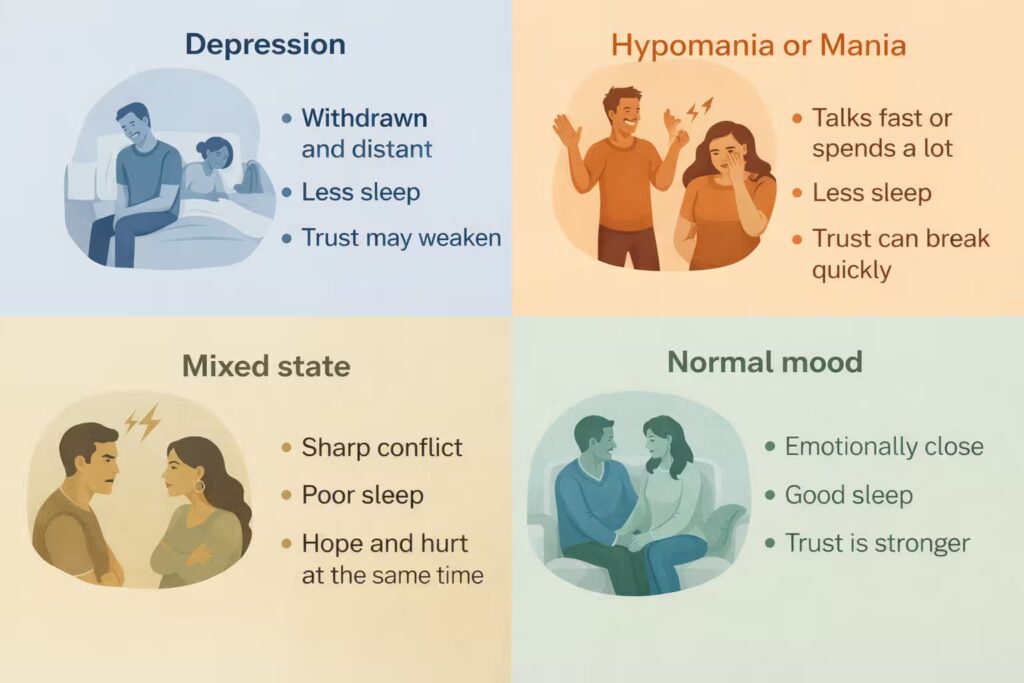
To understand bipolar disorder and relationships, you have to separate the person from the episode. Bipolar disorder causes shifts in mood, energy, activity, concentration, sleep, and behavioral health. During mania or hypomania, a person may feel fast, driven, irritable, overly confident, sexual, impulsive, or unusually certain. During depression, that same person may feel flat, hopeless, mentally slow, ashamed, or emotionally unavailable. These changes can interfere with work, intimacy, parenting, and daily routines. A partner often experiences those shifts as inconsistency, rejection, or unpredictability, even when that was never the intention.
This is also why people ask how does bipolar affect relationships and how a person with bipolar thinks in relationships. During an elevated episode, thoughts can race, judgment can narrow, and impulses can win. During depression, thinking may slow down, concentration may drop, and negative beliefs can take over. A person may sincerely love their partner and still act unlike themselves when symptoms are strong. That does not erase responsibility, but it does explain why love alone cannot stabilize the relationship. Insight, treatment, and repair matter just as much as emotion.
Why bipolar relationships fail is often the wrong question
One reason the phrase why bipolar relationships fail is so misleading is that it sounds absolute. It implies a diagnosis automatically ruins love. That is not what the evidence or the best clinical guidance shows. The more accurate pattern is that relationships struggle when symptoms are not managed, early warning signs are ignored, treatment is inconsistent, or one partner becomes the entire safety net. In other words, the illness can raise the level of strain, but the relationship usually breaks under repeated patterns that never get repaired. That is a big difference, and it is the difference many ranking articles only partly explain.
Common reasons why bipolar relationships fail
Untreated symptoms or weak treatment follow-through
The most common answer to why bipolar relationships fail is not romance. It is stability. Bipolar disorder often requires lifelong treatment. When medication is stopped, therapy is skipped, sleep is disrupted, or symptoms are minimized, the relationship often becomes a place where preventable damage repeats. One episode may lead to spending, risky sex, rage, quitting jobs, disappearing, or saying things that cannot easily be forgotten. Then comes shame, conflict, and emotional cleanup. Couples can survive a hard season. They struggle much more when the same cycle happens again and again with no real plan to change it.
Depression, emotional detachment, and the feeling of being shut out
A second reason why bipolar relationships fail is that depressive episodes often look like loss of love when they are really loss of energy, hope, and emotional access. This is where terms like emotional detachment enter the picture. A depressed partner may text less, cancel plans, avoid touch, stop talking, or look numb. They may think they are a burden and convince themselves their partner would be better off without them. The other partner then feels abandoned and confused. Over time, both people feel alone in the same relationship. That is how silence becomes distance and distance becomes a breakup risk.
Hypomania, mania, and trust damage
When people ask can you trust a bipolar person, they are often reacting to behavior that happened during mania or hypomania. Elevated states can bring less sleep, more confidence, faster speech, impulsive decisions, hypersexuality, substance use, and a stronger pull toward pleasure without enough regard for consequences. In relationships, that may show up as cheating, lying by omission, grand promises, reckless spending, or abruptly deciding the relationship is the problem. The trust injury can be deep because the behavior feels so sudden. The partner asks which version was real. The answer is usually harder than either person wants. Both the love and the damage can be real.
Bipolar anger toward spouse and mixed states
Another under-covered answer to why bipolar relationships fail is irritability, especially during mixed episodes. A mixed episode includes both manic and depressive symptoms. That can mean restless energy plus hopelessness, or racing thoughts plus despair. In real life, that often looks like sharp anger, suspicion, short temper, and explosive conflict. This is where bipolar anger towards spouse becomes a real search topic. It is not always loud. Sometimes it is sarcasm, contempt, coldness, or blaming. Partners can handle sadness more easily than they can handle repeated emotional whiplash. If anger becomes intimidation, threats, or abuse, the issue is no longer just symptom management. It becomes a safety issue.
Sleep loss, routine collapse, and the breakup cycle
Many couples do not realize how much sleep protects their bond. Lack of sleep can trigger or worsen elevated states, and once routine collapses, conflict often rises with it. The couple starts living inside a breakup cycle. One partner notices warning signs. The other feels controlled. Fights get bigger. Promises get made. Follow-through fades. Then another episode lands, and the relationship takes another hit. This is one of the clearest reasons why bipolar relationships fail over time. The breakup is often not about one event. It is about accumulated instability with no structure strong enough to hold the relationship together.
Caregiver burnout, codependency, and resentment
Bipolar disorder does not only affect the diagnosed partner. It changes the emotional load inside the relationship. The non-diagnosed partner may become part lover, part nurse, part crisis monitor, part financial backstop, and part therapist. That role can quietly hollow a relationship out. Studies and reviews on couple functioning describe caregiving burden, self-sacrifice, emotional strain, and difficulty accurately seeing the other partner’s experience. Many spouses report distress in practical areas like finances, jobs, and household responsibilities. Once burnout sets in, compassion often turns into resentment. By then, both people feel unseen.
Money, sex, parenting, and daily life pressure
A relationship rarely ends because of one abstract diagnosis. It usually ends because the diagnosis keeps colliding with real life. Bipolar symptoms can affect intimacy, libido, work stability, parenting stress, and financial decisions. During elevated states, sex drive may rise and judgment may fall. During depression, desire may disappear. Medication can also affect sexual functioning. Work problems can push one partner into carrying more financial weight. Parenting stress can trigger episodes. All of this explains why bipolar relationships fail in practical terms. Love may still be present, but daily life becomes too hard to manage without support and structure.
Bipolar 2 in relationships is often missed
Bipolar 2 in relationships deserves special attention because it is easier to overlook. Bipolar II includes hypomania rather than full mania, and hypomania can look productive, charismatic, creative, or even attractive at first. That means couples may miss the pattern until depression hits hard, or until hypomania shows up as irritability, risky choices, overspending, poor judgment, or emotional inconsistency. NIMH notes that bipolar II is defined by depressive and hypomanic episodes, and that many people spend long stretches in low mood. That can make the relationship feel like an exhausting swing between intensity and withdrawal.
Bipolar I vs Bipolar II in Relationships
|
Type |
Condition |
Reality |
Myth |
|---|---|---|---|
|
Bipolar I |
Full mania, often major disruption |
Sudden intensity, impulsive decisions, strong conflict, major trust breaks |
People think it is only “high energy” when it can be severe |
|
Bipolar II |
Depression plus hypomania |
Long emotional distance, inconsistency, periods of closeness followed by withdrawal |
People think it is “milder,” but relationships can still suffer deeply |
|
During depression |
Low energy, guilt, hopelessness, low interest |
Emotional detachment, less affection, social withdrawal |
The partner may wrongly assume love is gone |
|
During elevated states |
Racing thoughts, less sleep, poor judgment |
Fast promises, irritability, risky behavior, anger, overspending |
The intensity may look like confidence or passion at first |
Do bipolar people split, and how does a person with bipolar think in relationships
People often ask do bipolar people split. That phrase needs correction. In mental health language, splitting is more strongly associated with borderline personality disorder, where a person may shift into black-and-white views of others. Bipolar disorder is different. It is more episodic. That said, bipolar episodes can still change how a person thinks about the relationship. During mania or hypomania, the partner may suddenly seem boring, controlling, or unnecessary. During depression, the person may believe they are unloved, trapped, or impossible to love. So the experience can look similar from the outside, but the clinical pattern is not the same.
Can you trust a bipolar person
The fair answer to can you trust a bipolar person is yes, but not because trust should be automatic. Trust is built the same way it is in any relationship. It grows through honesty, consistency, accountability, treatment, and repair after harm. A diagnosis does not make someone untrustworthy. Untreated symptoms, denial, repeated dishonesty, and refusal to protect the relationship do. The strongest pages in the SERP often stop at “yes, healthy relationships are possible.” That is true, but incomplete. Trust comes back when the person living with bipolar disorder accepts the condition, learns triggers, sticks with treatment, respects boundaries, and does the slow work of repair.
What happens when you ignore a bipolar person, and what about bipolar ghosting duration
The search phrase what happens when you ignore a bipolar person usually comes from hurt and frustration. In practice, the answer depends on the person, the stage of the illness, and the conflict itself. Silence may increase shame, isolation, anger, or panic. It may also simply deepen the distance that was already forming. But the bigger truth is this: ignoring is not a treatment strategy. If someone is withdrawing because of depression, the real issue is support and clinical care. If someone is escalating in mania, the real issue is safety, de-escalation, and medical help.
The same goes for bipolar ghosting duration. There is no clinical clock for it. Bipolar mood episodes can last days, weeks, or longer, so relationship withdrawal can also vary widely. That is an inference from how episodes work, not a formal diagnostic rule. What matters more than guessing the timeline is asking whether the pattern is changing. Is the person getting help, repairing the damage, and communicating better over time, or are you stuck in the same loop with new excuses each month.
Bipolar exes always come back is a myth, and divorce regret is real but not universal
The phrase bipolar exes always come back is catchy, but it is not a rule. Some people reconnect after an episode ends, shame settles in, or loneliness returns. Others do not. Some come back because they regret what they said. Others come back because the cycle itself is unresolved. That is why reunion alone should never be mistaken for recovery. If the relationship comes back without treatment, boundaries, and accountability, the same pain often comes back too.
This also explains divorce regret after bipolar-driven conflict. Once the mood episode passes, the person may see the damage more clearly and feel deep remorse. But regret does not automatically rebuild safety or trust. A partner should never stay only because the other person feels sorry. The real question is whether there is consistent change after the regret. If not, the apology becomes part of the cycle rather than the start of repair.
Dating someone with bipolar: what helps relationships last
If you are dating someone with bipolar, optimism is fine, but realism matters more. Strong relationships are not built on tiptoeing around symptoms or pretending love will fix everything. They are built on structure. The couples who do better usually make their expectations visible early and repeat them often.
What helps most is simple and practical:
- Talk openly about diagnosis, triggers, past episodes, treatment, and what support should look like
- Protect sleep, routine, and substance boundaries because these often affect stability
- Notice early warning signs instead of arguing only after the damage is done
- Use couples therapy or family-focused therapy when conflict keeps repeating
- Separate an episode from the person, but do not separate the person from responsibility
- Make a plan for money, sex, conflict, and crisis response before the next episode happens
This is where most articles lose depth. They say “communicate more,” but they do not explain what to communicate about. The real work is not vague positivity. It is building a shared system that reduces chaos before it starts.
Men, women, and the danger of stereotypes
Searches around men and woman often suggest people want gender-based answers, but broad stereotypes can mislead. Bipolar disorder does not create one “male pattern” and one “female pattern” in love. People differ by illness severity, trauma history, attachment style, substance use, treatment access, personality, and support system. Some men may express more irritability. Some women may be misread as simply anxious or emotional. But the deeper truth is that symptoms do not follow internet clichés. The best relationship advice stays behavior-based, not stereotype-based. Watch for honesty, routine, respect, repair, and safety. Those signs matter more than gender.
How to tell if a bipolar man loves you
People also ask how to tell if a bipolar man loves you, but there is no special hidden code. The reliable signs are the same ones that matter in any healthy relationship. Love shows up as consistency, not intensity. It shows up as keeping appointments, telling the truth, owning mistakes, protecting your emotional safety, and staying engaged with treatment when symptoms affect the relationship. Grand passion during hypomania can feel convincing. So can sudden closeness after conflict. But those moments do not prove love by themselves. Long-term care does. If he loves you, you will see effort that continues after the mood shifts, not only during the highs.
When love is not enough
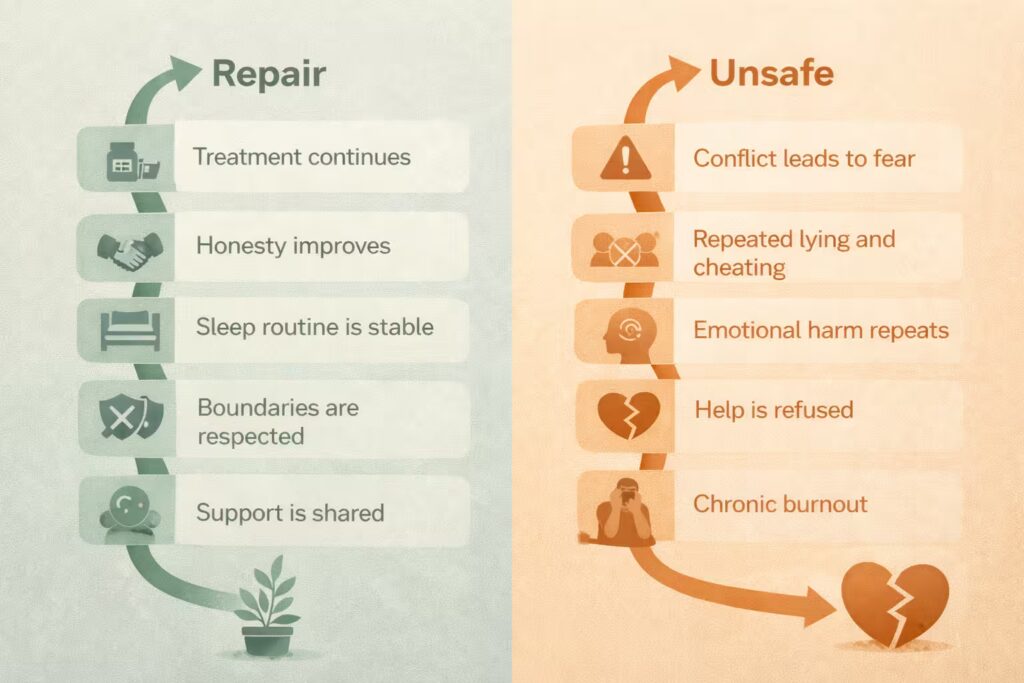
The hardest truth in this topic is that some relationships should end. If one partner refuses treatment, repeatedly becomes dangerous, drains the other person into chronic fear, or turns every episode into an excuse for emotional abuse, love is no longer enough. Healthline’s breakup guidance is useful here because it focuses on signs of an unhealthy relationship, including burnout, fear, constant anxiety, and feeling like your own needs no longer matter. If you feel unsafe, choose safety first. If you are always the caretaker, step back and assess the real cost.
Important warning signs include:
- You feel scared during conflict
- You are covering up spending, cheating, or threats
- Treatment stops and the pattern keeps worsening
- You are losing sleep, work focus, or peace just trying to hold the relation
- The relationship now runs on crisis, apology, and relapse instead of trust
Sometimes the healthiest answer to why bipolar relationships fail is simple. They fail because one or both people can no longer stay well inside them.
Frequently Asked Questions
Conclusion
So, why bipolar relationships fail is not really a one-line question. These relationships usually break down when symptoms stay untreated, mood episodes keep damaging trust, depression turns into emotional detachment, hypomania turns into impulsive choices, anger takes over conflict, and one partner ends up carrying the whole system alone. But that is only half the truth. The other half is that many relationships do survive bipolar disorder when both people respect the illness, protect sleep and routine, communicate early, and treat repair as seriously as romance.
The most helpful way to think about bipolar and relationships is this. The diagnosis raises the stakes, but it does not write the ending. Patterns do. If the pattern is honesty, treatment, boundaries, and repair, the relationship has a chance. If the pattern is denial, chaos, silence, and repeated injury, the relationship will likely keep breaking no matter how strong the feelings are.