
What Is a Pathological Liar? Signs, Causes, and How to Cope
We all stretch the truth occasionally by exaggerating a story to get a laugh or saying we are “fine” when we are not. That is human. But some people lie constantly, compulsively, and often without any clear reason or personal benefit. If you have ever known someone like this, you understand just how disorienting and emotionally exhausting it can be. So what is a pathological liar, and what actually drives this behavior?
This article digs deep into the psychology of compulsive deception, what it means, what causes it, how to recognize it, and most importantly, what you can do about it.
Pathological Liar Definition: What Does It Actually Mean?
The pathological liar definition, in psychological terms, refers to a person who lies habitually, excessively, and persistently and often without any obvious motive or personal gain. Unlike the occasional white lie or strategic deception, a pathological liar fabricates stories as a default mode of communication. The lies can range from trivial and harmless to elaborate and deeply damaging.
The word “pathological” comes from the Greek “pathos,” meaning suffering or disease. When applied to lying, it signals that the behavior goes beyond normal social dishonesty. It is compulsive, deeply ingrained, and often outside the individual’s conscious control.
Pathological liar meaning first appeared in psychiatric literature in the early 20th century. German physician Anton Delbrück coined the clinical term “pseudologia fantastica” in 1891 to describe patients who told dramatic, self-aggrandizing falsehoods that were internally consistent yet detached from reality. That foundational concept remains central to how clinicians and researchers understand the condition today.
What Do You Call Someone Who Lies All the Time?
What do you call someone who lies all the time? The most clinically recognized term is “pathological liar” or “compulsive liar,” though these labels are sometimes used interchangeably. There are, however, meaningful distinctions worth knowing:
|
Term |
Key Characteristic |
|
Pathological Liar |
Lies habitually with elaborate storytelling; lies serve a psychological function |
|
Compulsive Liar |
Lies out of deep-seated habit; may feel genuinely unable to stop |
|
Chronic Liar |
Lies frequently over a long period; can be deliberate and strategic |
|
Pseudologia Fantastica |
Clinical term for dramatic, self-serving, internally coherent fabrications |
|
Mythomania |
Older psychiatric term for excessive or uncontrollable lying |
While none of these are standalone diagnoses in the DSM-5 (the Diagnostic and Statistical Manual of Mental Disorders, Fifth Edition), they describe well-recognized behavioral patterns frequently linked to deeper psychological conditions.
Pathological Lying vs. Compulsive Lying: Is There a Difference?
Many people use these two terms interchangeably, but mental health professionals draw a subtle and important line between them.
A compulsive liar lies out of habit — much the way some people compulsively check their phone or bite their nails. The behavior feels automatic and difficult to interrupt. There is often no elaborate strategy involved; it is simply the path of least resistance.
A pathological liar, by contrast, tends to construct more elaborate and internally consistent false narratives. These stories frequently cast the liar in a favorable light—as a hero, a victim of injustice, or a highly accomplished individual. The fabrications serve a psychological purpose, such as protecting self-esteem, avoiding accountability, or managing deep-seated shame. Over time, pathological liars may begin to believe their own stories, which significantly complicates both diagnosis and treatment.
What Causes Pathological Lying?

Understanding what a pathological liar is requires examining the roots of the behavior. No single cause explains it fully. Research points to a combination of neurological, psychological, and environmental factors:
1. Underlying Mental Health Conditions
Pathological lying is rarely a standalone problem. It frequently appears alongside—or as a symptom of—diagnosable conditions, including
- Narcissistic Personality Disorder (NPD): People with NPD often lie to maintain a grandiose self-image and shield their ego from perceived criticism or failure.
- Borderline Personality Disorder (BPD): Impulsivity and intense fear of abandonment can drive dishonesty as a maladaptive coping mechanism.
- Antisocial Personality Disorder (ASPD): Associated with sociopathy, this condition involves a pervasive pattern of manipulation, deceit, and disregard for others.
- Histrionic Personality Disorder: Characterized by an intense need for attention, which chronic lying helps to secure and sustain.
- Bipolar Disorder: During manic episodes, individuals may fabricate stories or make unrealistic claims with genuine conviction.
- ADHD: Impulsive lying is particularly common in children and adolescents and is sometimes associated with attention-deficit/hyperactivity disorder.
2. Neurological Differences
A significant 2005 neuroimaging study conducted at the University of Southern California, led by researcher Dr. Yaling Yang, found that pathological liars had notably more white matter in the prefrontal cortex compared to healthy controls and individuals with other behavioral conditions. White matter facilitates neural connections throughout the brain. A greater volume may equip pathological liars with a heightened capacity for complex, multi-layered deception — essentially, a brain more structurally capable of sustaining elaborate falsehoods.
3. Childhood Trauma and Learned Behavior
A significant number of pathological liars grew up in environments where honesty was dangerous — households marked by abuse, neglect, addiction, or severe unpredictability. In those contexts, lying became a survival strategy, a way to avoid punishment or create emotional safety. Over time, that adaptive behavior becomes hardwired into daily interaction.
4. Low Self-Esteem and Chronic Shame
Deep-seated feelings of inadequacy frequently fuel compulsive deception. Fabrication becomes a tool for constructing a version of oneself that feels more acceptable, impressive, or lovable — to others and, critically, to oneself.
5. Anxiety and Fear of Consequences
For some individuals, lying is purely anxiety-driven. The prospect of telling the truth — and facing judgment, rejection, or punishment — feels so overwhelming that deception feels safer, even when the actual stakes are low.
Warning Signs You Are Dealing With a Pathological Liar
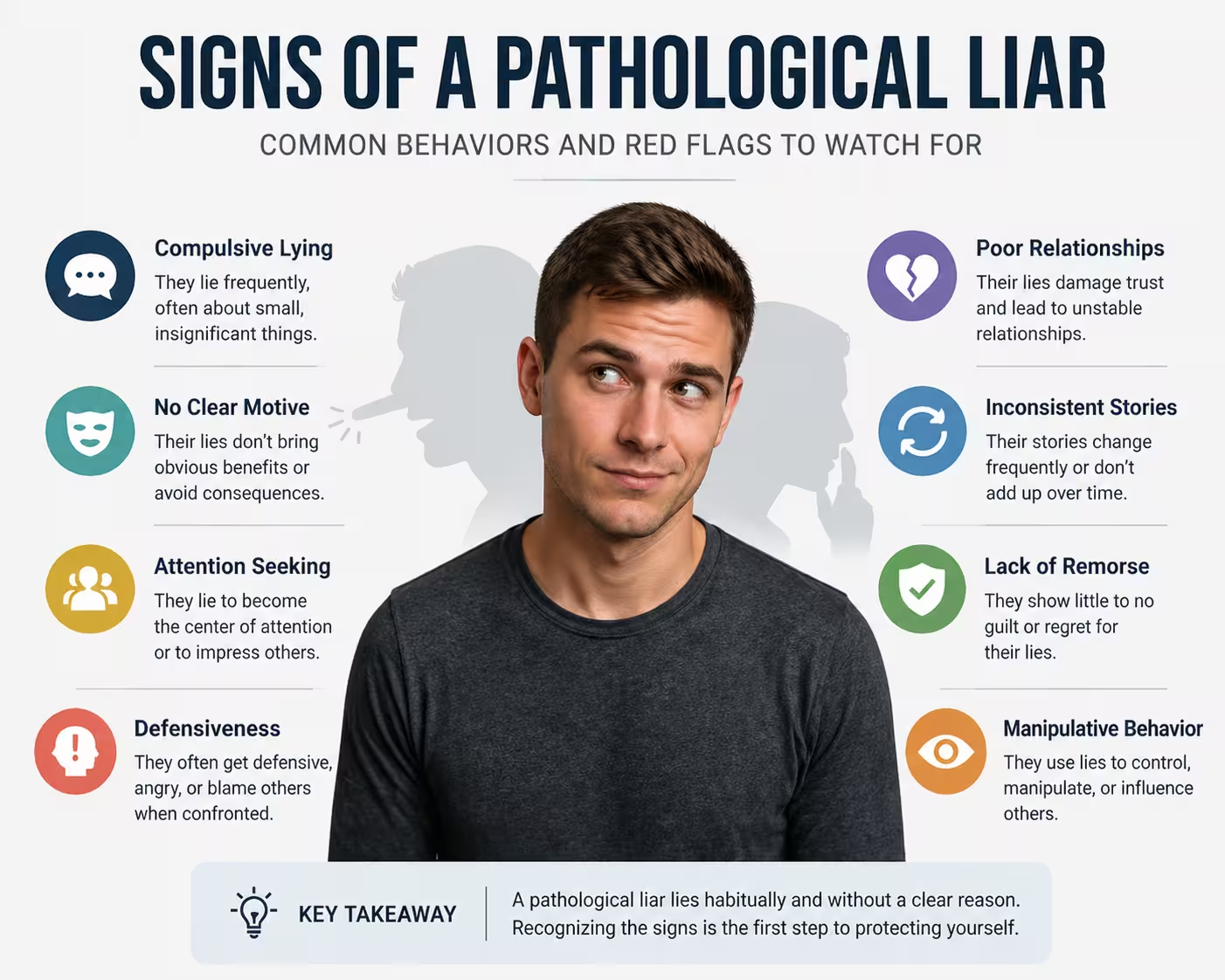
Identifying a pathological liar is not always straightforward. Skilled fabricators are often charming, socially fluent, and convincing. However, recognizable patterns tend to surface over time. Watch for these warning signs:
Behavioral Red Flags:
- Stories that constantly change—key details shift between tellings, yet the liar appears unaware of the inconsistencies
- Lying about things that do not matter — fabricating trivial facts when the truth would serve equally well
- Elaborate, self-serving narratives — tales that consistently position them as heroic, victimized, or exceptionally gifted
- Defensive reaction to doubt — becoming hostile, wounded, or accusatory when their accounts are questioned
- Lying even when honesty would benefit them — a hallmark indicator of compulsive or pathological patterns
- Inability to maintain a consistent timeline — dates, places, and people contradict each other across conversations
- Recruiting others to validate false stories — a more sophisticated form of social manipulation
Interpersonal Signs:
- You catch them in fabrications frequently, yet they never fully acknowledge the dishonesty
- They shift blame or reframe situations when confronted with evidence
- Other people in their circle report similar feelings of confusion or manipulation
- They appear to genuinely believe their own fabrications when pressed, even with contradictory evidence present
Is Pathological Lying the Same as Gaslighting?
Not exactly, but the two frequently overlap. Gaslighting is a specific form of psychological manipulation where someone deliberately causes another person to doubt their own memory, perception, and judgment. A pathological liar may gaslight unintentionally because they have constructed an alternative reality and genuinely operate from within it.
That said, some pathological liars are fully aware of their deception and use gaslighting deliberately to maintain control over others. Whether the manipulation is conscious or not, the effect on the people around them is similarly disorienting and psychologically damaging.
The Emotional Impact on People Around a Pathological Liar
Living or working with a pathological liar carries a measurable psychological cost. People close to such individuals commonly report:
- Chronic self-doubt — persistently questioning their own memory and perception
- Emotional exhaustion — the constant effort of separating fact from fiction
- Eroded trust — difficulty trusting others in future relationships
- Anxiety and hypervigilance — a state of constant alertness, waiting for the next revelation
- Grief and betrayal — mourning the relationship they believed they had
- Depression — particularly in long-term partnerships or family situations
These experiences are valid, documented, and recognized by mental health professionals. The disorientation caused by sustained deception is not a personal failing — it is a predictable response to an abnormal relational environment.
Can a Pathological Liar Change?
This is among the most frequently asked questions, and the honest answer is yes, but it is complicated.
Pathological lying can improve with professional treatment—particularly when an underlying condition is accurately identified and addressed. The key variables are:
- Willingness to seek help — which is challenging, because many pathological liars do not recognize their behavior as a problem
- Accurate clinical diagnosis—treating narcissism-driven lying requires different approaches than addressing anxiety-driven fabrication
- Long-term therapeutic commitment — meaningful change is rarely rapid
Cognitive Behavioral Therapy (CBT) is frequently used to help individuals recognize and interrupt the thought patterns driving dishonest behavior. Dialectical Behavior Therapy (DBT) is particularly effective for those with BPD-linked lying. Where lying is tied to mood disorders or ADHD, medication may complement therapy.
The prognosis is more guarded when pathological lying accompanies antisocial personality disorder or when the individual firmly denies that any problem exists. Even in difficult cases, however, meaningful improvement is documented and possible with sustained, professional support.
How to Protect Yourself and Establish Boundaries

If you suspect someone in your life is a pathological liar, your well-being matters just as much as understanding their psychology. Mental health professionals generally recommend the following:
Trust Your Own Observations
Keep a private record of inconsistencies if necessary. Seeing a pattern documented in writing helps affirm your perception — especially when you have been repeatedly made to feel like the one who is confused or overreacting.
Avoid Engaging in Debates Over Facts
Arguing with a pathological liar about what is true is almost always unproductive. They are either convinced of their own version of events or highly skilled at deflection. State your perspective calmly and without escalation—then hold your position.
Set Clear and Consistent Limits
Define what behavior is unacceptable and what consequences will follow. Be prepared to enforce those consequences consistently. Limits without enforcement signal that deception carries no meaningful cost.
Seek Independent Support
A therapist or counselor can help you process what you are experiencing, validate your perceptions, and develop strategies for protecting your mental health—independent of whether the other person seeks treatment.
Evaluate the Relationship Honestly
Not every relationship with a pathological liar is salvageable or worth preserving. Assessing what the relationship is actually costing you — emotionally, psychologically, and practically — is a necessary and responsible act of self-care.
When to Seek Professional Help
Consider reaching out to a licensed mental health professional if:
- Someone close to you appears to be a pathological liar and their behavior is affecting your daily mental health
- You notice compulsive dishonesty in your own behavior and genuinely want to change
- You are experiencing symptoms of anxiety, depression, or trauma-related stress as a result of the relationship
- Children in your home are being regularly exposed to sustained deception
A licensed psychologist, psychiatrist, or licensed clinical social worker (LCSW) can provide a proper assessment and develop a treatment plan suited to the specific situation.
Key Facts at a Glance
- Pseudologia fantastica is the clinical term for pathological lying, first described by Anton Delbrück in 1891
- Pathological lying is not a standalone DSM-5 diagnosis but is recognized as a symptom of several personality disorders
- It is most commonly associated with NPD, BPD, ASPD, and anxiety-spectrum conditions
- A 2005 USC neuroimaging study identified structural differences in the prefrontal cortex of pathological liars
- CBT and DBT are among the most evidence-supported therapeutic approaches
- Behavior can meaningfully improve with professional treatment when underlying conditions are addressed
- People close to a pathological liar frequently experience anxiety, depression, and lasting damage to their sense of trust
Conclusion
Understanding what a pathological liar is is the first step toward navigating one of the more disorienting and emotionally demanding interpersonal experiences a person can face. The pathological liar meaning extends far beyond someone who bends the truth occasionally—it describes a deeply ingrained behavioral pattern rooted in psychological complexity and, often, genuine suffering.
Whether you are trying to make sense of someone in your life, recognize patterns in your own behavior, or simply expand your understanding of human psychology, the most important takeaway is this: pathological lying has identifiable causes, recognizable warning signs, and genuine treatment pathways. No one has to face it without support, information, or options.