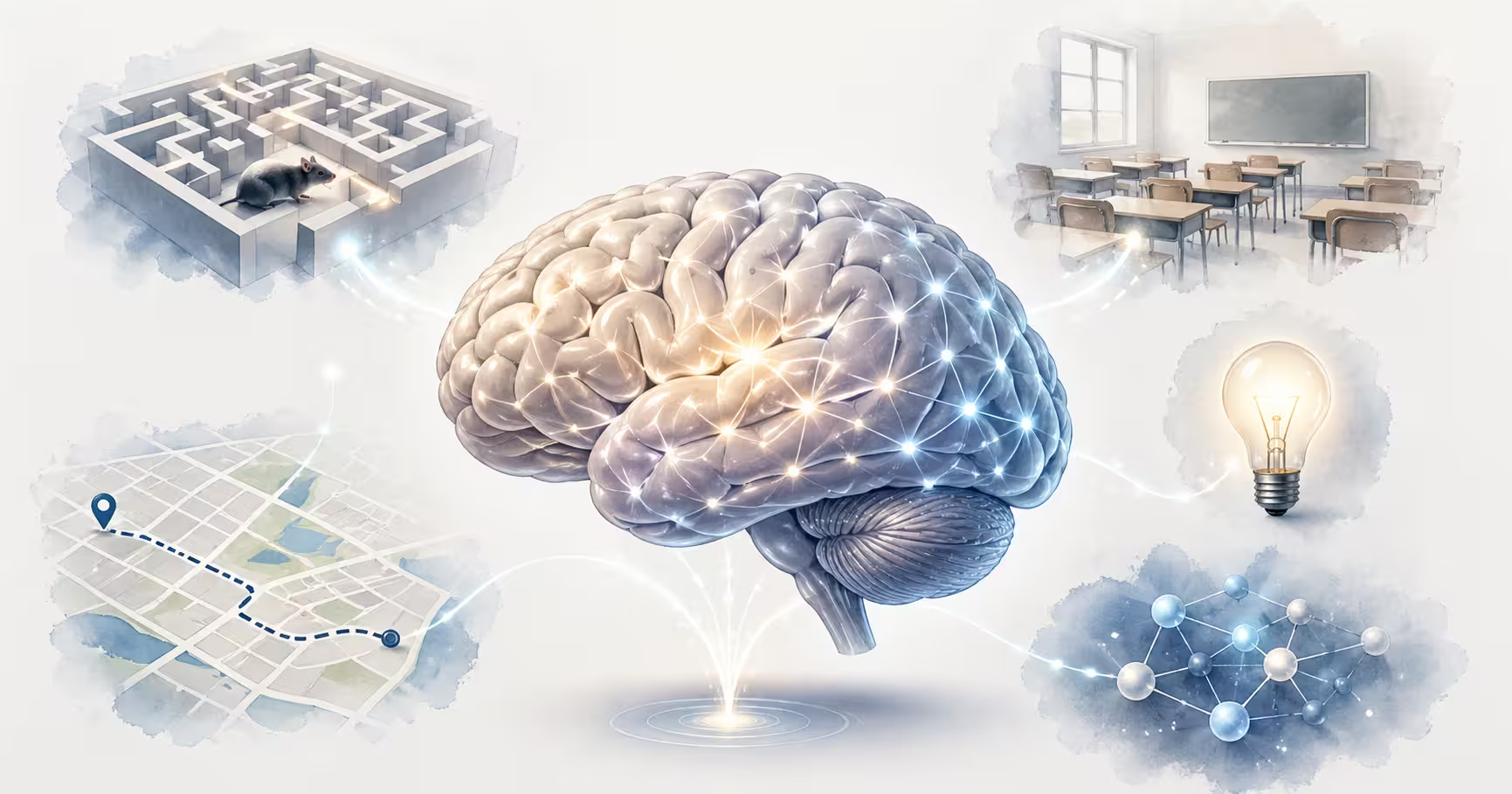
Latent Learning in Psychology: Meaning, Examples, and How It Works
Latent learning is hidden learning that happens without an immediate reward or visible action. The knowledge stays stored in the mind and appears later when there is a reason to use it. In psychology, latent learning explains how people and animals can learn through exposure, observation, and experience before showing that learning in behavior.
Latent learning is one of the most practical ideas in psychology because it explains something people notice every day: you can learn without realizing it. A child may watch a parent cook for years and then prepare a simple meal with surprising confidence. A new employee may quietly observe a software process and later use it when a task finally appears. A driver may pass the same streets for months and suddenly know a shortcut during a traffic jam.
This hidden form of learning matters because it separates knowledge from performance. The mind may store routes, patterns, habits, social rules, and problem-solving clues long before anyone can see proof of them. When a clear reason appears, the stored knowledge comes forward.
Direct Answer
Latent learning is learning that happens without an immediate reward, punishment, or visible behavior change. The knowledge stays hidden until motivation, need, or a useful situation brings it out. This matches standard psychology descriptions that define it as learning not immediately expressed in behavior and often revealed later when an incentive appears.
In simple words, someone can learn by exposure, exploration, or observation, even when they are not trying to perform. The result may appear later as better navigation, faster problem-solving, smoother social behavior, or stronger task performance.
Basic Meaning
The question “what is latent learning” is best answered by focusing on two parts: hidden knowledge and delayed use. A person or animal takes in information from the environment, but does not show that learning right away. The learning becomes clear later when there is a reason to act.
This idea is different from the view that learning must be proven instantly through behavior. For example, a student may listen quietly during a science lesson and appear passive. Weeks later, during a project, that same student may use the exact idea correctly. The knowledge was not absent. It was simply not expressed yet.
What Is Latent Learning in Psychology?
In psychology, the phrase refers to a cognitive form of learning in which information is acquired without obvious reinforcement and later appears when there is motivation to use it. It helped psychologists understand that the mind does more than react to rewards and punishments.
This concept shows that humans and animals form mental representations, expectations, and internal maps. Those mental structures can guide behavior later. In daily life, this means people may learn routines, emotional patterns, workplace norms, and physical spaces through repeated exposure.
Latent Learning Psychology Definition
A clear definition is hidden learning that is not shown at the time it occurs but is inferred later from improved performance when an incentive or need appears.
The most important point is that learning and performance are not the same. Learning is the internal change. Performance is the visible action. A person may learn today but perform tomorrow, next month, or only when the right situation makes the information useful.
Key Facts
|
Point |
Explanation |
|
Main idea |
Knowledge can be acquired before it is shown. |
|
Reinforcement |
Not required during the learning stage. |
|
Performance |
Often appears later when motivation exists. |
|
Famous researcher |
Edward C. Tolman helped popularize the concept. |
|
Classic evidence |
Maze studies with rats showed delayed performance after reward was introduced. |
|
Related concept |
Cognitive maps, or mental representations of spaces and routes. |
|
Everyday value |
Helps explain navigation, classroom learning, job training, and social understanding. |
A Brief History
The most famous name linked with latent learning is Edward C. Tolman, an American psychologist known for challenging strict behaviorist ideas. During the early 1900s, many behaviorists believed that learning mainly happened through direct reinforcement. If a behavior was rewarded, it became stronger. If it was not rewarded, it was less likely to appear.
Tolman’s work suggested a deeper process. He believed organisms could build knowledge about their surroundings even when no reward was present. This was a major shift because it treated the learner as an active thinker, not just a machine responding to stimuli.
The Tolman and Honzik Maze Experiment
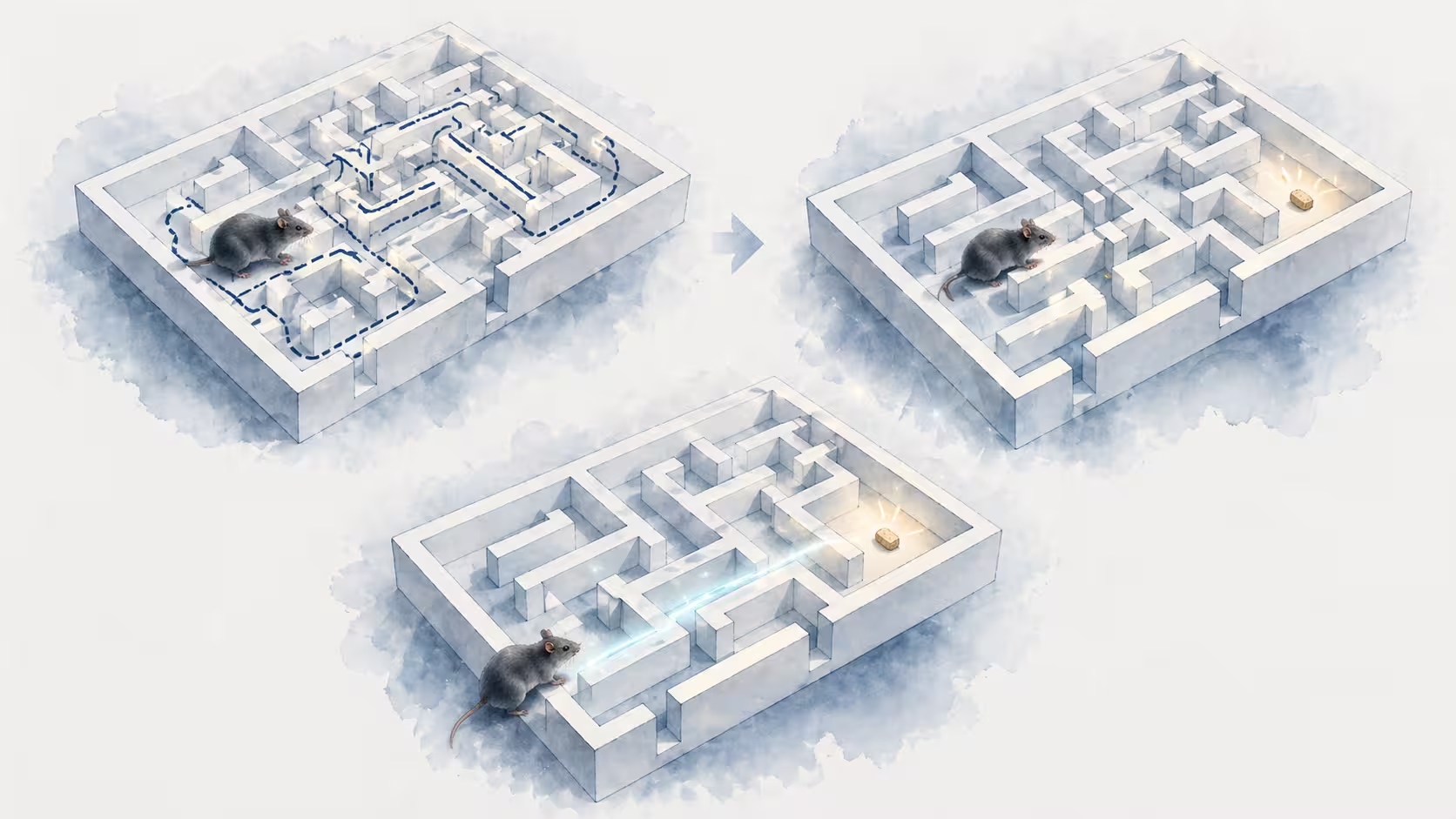
One of the best-known demonstrations came from maze research by Tolman and Honzik in 1930. In these studies, rats explored mazes under different reward conditions. Some rats received food every time they reached the end. Others received no food at first. A third group received no food for several days, then food was introduced.
The surprising result was that rats given delayed food improved quickly once the reward appeared. Their sudden improvement suggested they had already learned the maze layout during the no-reward period. They were not learning from scratch after food appeared. They were revealing knowledge that had been built earlier.
Why the Study Was Important
The maze findings were important because they showed that behavior does not always tell the full story. Before the reward was added, the rats did not appear to know much. After the reward appeared, their performance changed quickly.
This supported the idea of cognitive maps. A cognitive map is a mental representation of a place, route, or layout. Humans use cognitive maps when remembering a school hallway, a grocery store, a neighborhood, or the route between home and work. OpenStax also explains cognitive maps through Tolman’s maze work and everyday navigation.
How the Process Works in the Mind
Latent learning begins when the brain receives information from the environment. This information may include sights, sounds, sequences, locations, emotional cues, or repeated routines. The person may not focus deeply on every detail, but the mind can still organize patterns over time.
The process often works in three stages:
- Exposure: The person experiences a place, task, or situation.
- Storage: The brain keeps useful details in memory.
- Expression: The knowledge appears later when a reason exists.
For example, a child may ride in the back seat while a parent drives to school. The child may not be asked to give directions. After many rides, the child may still know landmarks, turns, and street names. The knowledge becomes visible only when someone asks, “Which way do we go?”
Latent Learning Examples in Everyday Life

The best examples are often ordinary. They happen at home, in school, at work, and in public places. Because this learning is quiet, people may not recognize it until the hidden knowledge becomes useful.
1. Learning a Route Without Trying
A person may walk through a college campus every day without memorizing the layout. Later, when a friend asks where the library is, that person gives accurate directions. The route was learned through repeated exposure, not formal study.
2. Watching Someone Cook
A teenager may watch a parent prepare rice, pasta, or eggs many times. No one gives a test or reward. Later, when the teen is alone, they remember the steps well enough to cook. The skill appears when need creates motivation.
3. Absorbing Classroom Ideas
A student may seem quiet during a lesson. They may not answer questions in class. Later, during homework or an exam, the student uses the concept correctly. The visible performance happened later, but the internal learning began earlier.
4. Workplace Training by Observation
A new employee may observe how coworkers handle customers, organize files, or use software. They may not perform the task during the first week. When assigned the task later, they complete it faster than expected because they built knowledge while watching.
5. Children Learning Social Rules
Children often learn social behavior by being around adults and other children. They notice when people say “please,” wait their turn, lower their voice indoors, or apologize after a mistake. These patterns may appear later in new social settings.
6. Pet and Animal Behavior
Animals can also gain hidden knowledge about spaces and routines. A dog may learn where treats are stored or which door leads outside without direct training. When motivated, the animal may use that knowledge to get what it wants.
Table: Hidden Learning in Common Situations
|
Situation |
What is learned quietly |
When it becomes visible |
|
Riding in a car |
Roads, turns, landmarks |
Giving directions later |
|
Sitting in class |
Concepts, examples, vocabulary |
Completing work or answering questions |
|
Watching coworkers |
Tools, routines, expectations |
Handling a task independently |
|
Visiting a store often |
Aisle locations and product sections |
Finding an item quickly |
|
Growing up in a household |
Manners, roles, routines |
Acting appropriately in a new setting |
Compared With Other Types of Learning
Latent learning is easier to understand when compared with other well-known forms of learning. It overlaps with some of them, but it is not identical.
|
Type of learning |
How it works |
Reward required? |
Behavior shown right away? |
Example |
|
Hidden learning |
Knowledge is acquired quietly and used later. |
No |
Not always |
Learning a route before needing directions |
|
Operant conditioning |
Behavior changes because of rewards or punishments. |
Usually yes |
Often yes |
Studying more after earning a good grade |
|
Classical conditioning |
A neutral signal becomes linked with a response. |
Not always |
Often yes |
Feeling hungry when hearing a lunch bell |
|
Observational learning |
A person learns by watching others. |
No direct reward needed |
Sometimes |
Learning a dance move by watching |
|
Insight learning |
A solution appears suddenly after mental processing. |
No |
Yes, when insight occurs |
Suddenly solving a puzzle |
The main difference is timing. In many learning types, behavior changes quickly and visibly. In hidden learning, the knowledge may stay quiet until the right trigger appears.

Why Motivation Matters
Motivation does not always create the learning. Sometimes it simply reveals what has already been learned. This is one of the most useful lessons from latent learning.
Imagine a student who has listened to Spanish phrases at home for years but rarely speaks. During a trip, the student suddenly understands signs and basic questions. The travel situation creates a need. The need pulls hidden knowledge into action.
Motivation can come from many sources:
- A reward, such as praise, a grade, or food
- A practical need, such as finding a route
- A problem that must be solved
- A social situation that requires the right response
- A deadline or responsibility
This explains why a person may seem unprepared in one setting but capable in another. The ability may exist, but the situation has not yet brought it out.
The Role of Cognitive Maps
A cognitive map is one of the strongest ideas connected to latent learning. It refers to an internal mental model of an environment. It helps people and animals understand where things are and how different places connect.

Cognitive maps are not limited to physical spaces. People can also form mental maps of routines, relationships, procedures, and systems. For example, someone may understand the “map” of a company’s workflow: who approves requests, where files go, when reports are due, and which steps come first.
Brain research later strengthened interest in spatial mapping. John O’Keefe identified place cells in the hippocampus, while May-Britt Moser and Edvard I. Moser discovered grid cells in the entorhinal cortex. These discoveries helped explain how the brain supports location and navigation, and they were recognized with the 2014 Nobel Prize in Physiology or Medicine.
Why This Concept Matters in Education
This form of learning has practical value in schools and colleges. Students do not always show what they know immediately. Some need time, context, or a meaningful task before their knowledge appears.
Teachers can support hidden learning by using:
- Real-life examples
- Repeated exposure to key ideas
- Visual maps and diagrams
- Practice without pressure
- Group discussion
- Project-based tasks
- Review sessions after a delay
A student who does not speak during a lesson may still be processing. A learner who struggles during the first activity may perform better after sleeping on the information, seeing more examples, or applying it in a different setting.
This does not mean assessment is unimportant. It means visible performance is only one window into knowledge.

Why This Concept Matters at Work
In the workplace, latent learning helps explain why observation and onboarding matter. New employees often learn by watching meetings, listening to customer calls, reviewing documents, and seeing how experienced team members solve problems.
Managers sometimes expect instant performance after instructions. But many skills develop through repeated exposure before they become visible. Helpful methods include shadowing, process walkthroughs, checklists, low-pressure practice, and reflection after tasks. This approach works well for customer service, software use, sales calls, teaching, hospitality, and leadership training.
Why This Concept Matters in Parenting
Parents often teach more through daily behavior than through direct instruction. Children watch how adults handle anger, solve problems, manage money, keep promises, and respond to mistakes. A child may not copy those behaviors immediately, but the patterns can become part of their understanding. This is why consistent modeling matters. Children absorb more than commands. They also absorb routines, values, tone, timing, and emotional habits.
Benefits and Limits
This idea is helpful, but it should be used carefully. Not every delayed behavior is proof of hidden learning. Sometimes people improve because they practiced, received feedback, or guessed correctly. Good explanations require context.
Benefits
- It explains why knowledge may appear later.
- It supports the difference between learning and performance.
- It recognizes mental processes such as memory and mapping.
- It helps teachers and trainers value exposure and context.
- It explains why exploration can be useful even without immediate rewards.
Limits
- It can be hard to measure because the knowledge is hidden.
- It may be confused with memory, imitation, or insight.
- It does not explain every kind of behavior change.
- Motivation affects whether the learning becomes visible.
- Early evidence relied heavily on animal maze studies.
A balanced view is best. The concept is powerful, but it works alongside other learning processes.
How to Use Latent Learning in Daily Life
People can use this idea to learn more naturally. The goal is to create useful exposure, then give the brain time and context to organize information.
Try these practical methods:
- Explore before testing yourself. Walk through a tool, space, or topic before expecting perfect performance.
- Watch skilled people carefully. Notice steps, language, timing, and decisions.
- Use spaced exposure. Return to the same idea over several days.
- Connect learning to a real need. Apply knowledge in a practical task.
- Build mental maps. Draw routes, workflows, timelines, or concept diagrams.
- Reflect briefly. Ask, “What did I notice?” or “What pattern keeps appearing?”
- Avoid judging too early. A quiet learner may still be building understanding.
These habits work for students, parents, teachers, employees, and anyone learning a new skill.
Common Myths
Myth 1: It Means Learning Without Attention
Hidden learning does not mean the brain records everything perfectly. Attention still matters. People remember more when information is repeated, meaningful, emotional, useful, or connected to what they already know.
Myth 2: It Only Happens in Animals
Animal research made the concept famous, but humans show similar patterns. People learn places, routines, words, gestures, and social expectations without formal instruction.
Myth 3: It Is the Same as Memorization
Memorization is usually intentional. Hidden learning may happen through exposure, exploration, and experience.
Myth 4: Rewards Do Not Matter at All
Rewards can matter, but they may reveal or strengthen knowledge rather than create it from nothing.
Quick Checklist
Use this simple checklist to decide whether a situation fits:
|
Question |
Yes means… |
|
Was the person exposed to the information earlier? |
Learning may have started before performance. |
|
Was there no immediate reward or test? |
The learning may have stayed hidden. |
|
Did performance improve once motivation appeared? |
Stored knowledge may have become visible. |
|
Can the person explain or use the pattern later? |
The internal representation may be real. |
|
Is there another explanation, such as practice? |
Consider other learning processes too. |
Real-Life Story
A college intern joins a small office. For the first two weeks, she mostly listens. She watches how the team names files, answers client questions, prepares meeting notes, and checks reports. She does not lead a task, and some people assume she has not learned much.
In week three, the manager becomes busy and asks her to prepare a simple client update. She opens the right folder, follows the naming format, uses the same reporting structure, and writes in the company’s usual tone. Her manager is surprised.
The performance looks sudden, but the learning was not sudden. She had built a quiet mental map of the workplace. When responsibility appeared, the knowledge became visible.
Frequently Asked Questions
Conclusion
Latent learning shows that the mind is always collecting, organizing, and storing useful information. People may learn routes before giving directions, absorb ideas before answering questions, and understand routines before performing tasks. This hidden process explains why performance can appear suddenly even when learning started much earlier.
The concept became famous through Tolman’s maze research, but its value reaches far beyond the laboratory. It applies to classrooms, homes, workplaces, travel, social behavior, and everyday problem-solving. The biggest lesson is simple: visible action is not the only sign of knowledge. Sometimes learning is already there, waiting for the right moment to come forward.