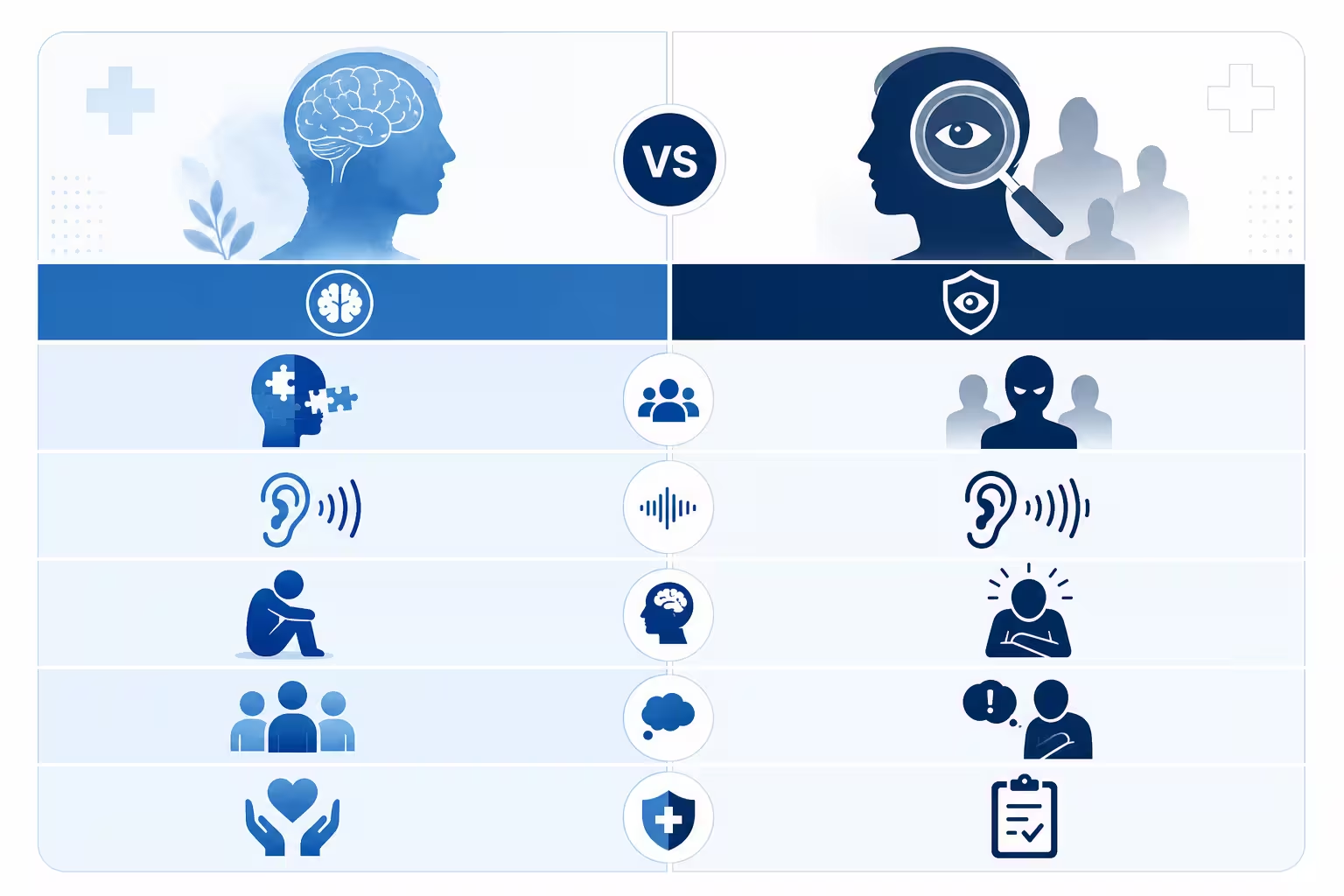

How to Get Motivated to Clean When Depressed
The dishes have been sitting there for three days. Laundry covers the floor. You want to clean, but every time you try, something heavy pulls you back down. That feeling is not laziness. That is depression at work, and it is more common than most people admit.
Depression drains your energy, kills motivation, and makes even simple tasks feel like climbing a mountain. As a result, the mess gets worse, and the mess makes the depression worse. It is a painful cycle. But there is a way out, and it does not require willpower or energy you do not have. This guide shows you how to get motivated to clean when depressed using small, realistic steps backed by mental health research.
Can Depression Make You Not Want to Clean?
Yes — and science explains exactly why. Depression affects the brain’s reward system. It lowers dopamine, which is the chemical that helps you feel motivated and satisfied. When dopamine drops, even small tasks like washing a cup feel pointless.
Beyond that, depression causes fatigue that sleep cannot fix. It affects concentration and makes decisions feel harder. Therefore, a messy house is not a sign of personal failure. It is a symptom of an illness, just like a fever is a symptom of infection.
Furthermore, depression often causes what experts call “executive dysfunction.” This means the brain struggles to plan, start, or finish tasks. So, even if you want a clean home, your brain cannot bridge the gap between wanting and doing.
Personal note from our wellness team: Many of our readers have shared that the moment they understood their messy home was a symptom — not a character flaw — they felt a significant shift in self-compassion. That shift is often the first step toward action.
Why Depressed People Neglect Hygiene and Cleaning
Depression does not just affect your mood. It physically changes how your brain works. Here is what happens inside:
- Low dopamine makes starting any task feel unrewarding
- High cortisol (stress hormone) leaves you feeling exhausted all day
- Disrupted sleep means you never feel truly rested
- Social withdrawal reduces accountability and external motivation
- Negative self-talk convinces you the effort is not worth it
Moreover, depression often comes with a condition called “anhedonia”—the inability to feel pleasure. When cleaning feels like it will lead to nothing good, the brain simply refuses to cooperate.
Understanding this is important. In fact, recognizing the root cause makes it easier to choose strategies that work with your brain, not against it.
How to Get a Depressed Person Motivated — Start Without Pressure
Whether you are helping yourself or someone you love, the key rule is this: remove pressure, lower the bar, and start with a tiny win.
Here is what actually helps:
1. Use the Two-Minute Rule
If a task takes less than two minutes, do it now. Wash one cup. Throw away one empty box. Put one item back where it belongs. These micro-actions send a signal to the brain that progress is possible. Consequently, momentum builds—naturally and slowly.
2. Set a Timer Instead of a Goal
Rather than saying “I will clean the bathroom,” say “I will clean for five minutes.” Set a timer. When it rings, you can stop completely. No guilt. No pressure. Often, however, you will find that you keep going because starting was the hardest part.
3. Play Music or a Podcast
Sound changes your environment. Put on a playlist or your favorite podcast. Suddenly, cleaning is no longer something you are doing alone in silence. The distraction reduces the emotional weight. Many people find they can clean through an entire episode without noticing.
4. Text a Friend for Accountability
Tell someone: “I am going to clean my kitchen sink right now.” Then do it. Then report back. This simple act of social accountability activates a different part of the brain — the part that wants to follow through on what it says.
5. Use Parallel Cleaning
Parallel cleaning means doing a cleaning task alongside something enjoyable — like watching a show. Clean during commercials. Put things away while listening to an audiobook. This method reduces resistance because the brain is partially occupied elsewhere.
How to Clean a Messy House When Depressed — A Room-by-Room Approach
A completely messy house feels impossible. So, instead of seeing it as a house, see it as individual zones. Tackle one zone at a time, and give yourself days or even weeks to finish the whole thing. There is no deadline here.
Zone 1: The Kitchen (Start Here)

The kitchen is the most important room to clean first because it directly affects your health. Piled dishes can grow mold and attract pests. Moreover, a clean kitchen makes eating healthier easier — and nutrition matters enormously for depression recovery.
- Clear the sink first—this is your single most important task
- Wipe the counter with a damp cloth
- Take out the trash—even a half-full bag
- Sweep the floor
Zone 2: The Bedroom
Your bedroom affects your sleep, and sleep directly impacts depression severity. Start small here too.
- Make the bed — even just pulling the covers up counts
- Put dirty laundry in a hamper, not on the floor
- Clear items off the nightstand
- Open a window for five minutes for fresh air
Zone 3: The Living Area
This space affects your mental state because it is where you spend most of your time. Clutter in your visual field creates cognitive load—meaning your brain is constantly processing the mess, even when you are trying to relax.
- Pick up all trash first and bag it
- Stack books, magazines, or papers in one pile
- Clear one flat surface completely
- Vacuum or sweep just the center of the room
Depression Cleaning Checklist: The 5-Step Quick-Win Method
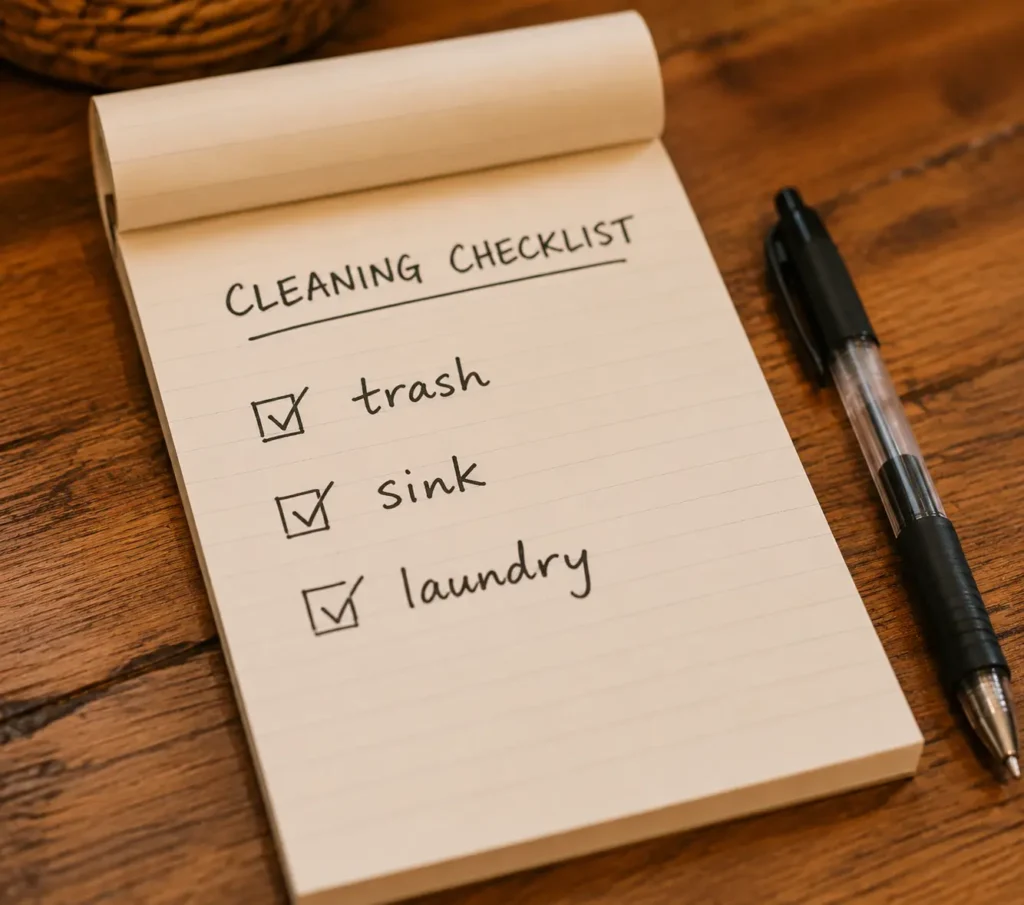
This checklist is designed specifically for depression cleanup days—when energy is low and motivation is near zero. Each step takes between 5 and 10 minutes. Do not do all of them in one go. Pick one. Celebrate finishing it.
|
Step |
Task |
Time Needed |
|
1 |
Pick up trash only |
5 minutes |
|
2 |
Clear the kitchen sink |
10 minutes |
|
3 |
Wipe one surface |
5 minutes |
|
4 |
Toss dirty laundry in basket |
5 minutes |
|
5 |
Sweep or vacuum one room |
10 minutes |
Importantly, you do not need to complete all five steps in a day. One step done is a genuine win. Two steps done is exceptional. Reward yourself after each step — with tea, a show, or simply lying down guilt-free.
What to Do When You Have No Motivation to Clean at All
Some days, even a five-minute timer feels like too much. On those days, the goal is not cleaning. The goal is simply surviving without making things worse.
Here is what to do instead:
These are not cleaning tasks. They are “bridge actions.” Each bridge action connects the paralysis you feel right now to a slightly more functional version of yourself. Over time, they add up.
One reader from our wellness community shared: “I spent months telling myself I would clean tomorrow. Then I started with just throwing away one empty water bottle. That was it. Three weeks later, I had cleaned my entire apartment—one small thing at a time.”
The 3:30 Rule for Cleaning — What It Is and How It Helps
The 3:30 rule is a productivity concept adapted for mental health. Here is how it works: At 3:30 PM every day, you do one small cleaning task. That is it. Nothing more.
The reason 3:30 PM works well is that it sits between two natural energy dips—the midday slump and the late-afternoon fatigue. Many people find this window slightly more manageable. Furthermore, choosing a specific time eliminates decision fatigue. You do not have to decide when to clean—the time decides for you.
For people managing depression, routine is a powerful tool. However, the routine must be small enough that skipping it once does not feel catastrophic. The 3:30 rule meets that standard perfectly.

Match Your Cleaning Level to Your Mood
Not every day is the same. On better days, do more. On harder days, do less. This table helps you figure out the right cleaning action based on how you feel right now:
|
How You Feel |
What to Do |
|
Completely drained |
Only 2 minutes: throw trash away |
|
A little low but okay |
5-minute sink clean + one wipe-down |
|
Moderate energy |
Full depression cleaning checklist, 3 tasks |
|
Better than usual |
Tackle laundry + one full room |
The goal is never perfection. The goal is simply doing something — anything — that does not make things worse.
How Clutter Affects Depression
Research published by mental health organizations consistently shows that cluttered environments increase cortisol levels. In other words, a messy home can literally make depression worse. This is not about judgment—it is about brain chemistry.
Conversely, cleaning — even for five minutes — can trigger a small dopamine release. Completing a task, however minor, activates the brain’s reward circuit. Therefore, cleaning is not just a physical activity. It is a form of mental health self-care.
Learn more: Understanding the Link Between Mental Health and Clutter — Mayo Clinic
Practical Tips for Depression Clean-Up Days
Beyond the checklist, here are proven strategies that help on the hardest days:
Lower Your Standards — Temporarily
A clean-enough home is better than a perfect home that never gets cleaned. “Clean enough” means safe, functional, and less visually chaotic. Let go of what it should look like and focus only on what makes life slightly easier.
Clean in Bursts, Not Marathons
A 3-minute burst of cleaning followed by 10 minutes of rest is more sustainable than an hour-long session that drains you completely. Additionally, short bursts are easier to start because the brain does not perceive them as threatening.
Use Supplies That Are Easy to Access
If the cleaning spray is buried under the sink, you are less likely to use it. Keep supplies visible and accessible. Put a small basket with wipes and spray on the counter. Reduce the steps between deciding to clean and actually cleaning.
Ask for Help Without Shame
Depression is a medical condition. Asking for help cleaning, whether from a friend, family member, or professional cleaning service, is not weakness. It is reasonable, practical, and often necessary. In fact, many people find that having someone clean alongside them is far easier than cleaning alone.
Track Your Progress Visually
Keep a simple journal or a checklist on your phone. Every time you complete even a small task, mark it. Visual proof of progress counteracts the depression-driven belief that “nothing is getting better.” Over time, the list becomes evidence of your strength.
When to Seek Professional Support
Cleaning struggles are often a signal — not just of a messy house, but of a mind that needs support. If you notice any of the following, consider speaking with a mental health professional:
- You have not been able to clean for several weeks or months
- The state of your home is affecting your health, relationships, or work
- You feel shame, hopelessness, or fear about the mess
- You are avoiding friends or family because of your home’s condition
- Basic hygiene tasks like showering feel impossible
Therapists who specialize in depression can help you work through the root cause — not just the symptoms. Cognitive behavioral therapy (CBT) in particular is highly effective for breaking cycles of avoidance and inaction.

Conclusion
Depression makes cleaning feel impossible — and that is the truth. Nevertheless, impossible does not mean forever. It means not right now, not in the way you used to do it, and not without help. The strategies in this guide are built for real people dealing with real mental illness, not idealized productivity machines.
Start with the smallest possible action. Do not judge it. Do not compare it. Simply do it. Then rest. Then, when you are ready, do one more thing. Over time, those small things become a cleaner home, a slightly lighter mind, and evidence that you are capable of more than depression tells you. You are not your mess. And you are not alone.
Frequently Asked Questions
Can depression make you not want to clean?
Yes, absolutely. Depression disrupts brain chemistry — particularly dopamine, which drives motivation. It also causes fatigue, executive dysfunction, and negative self-talk. All of these combine to make cleaning feel overwhelming or pointless. This is a medical symptom, not a personal failing.
What is the 3:30 rule for cleaning?
The 3:30 rule means committing to one small cleaning task every day at 3:30 PM. The specific time reduces decision fatigue, and the small scope keeps the commitment manageable. It is particularly helpful for people with depression because it builds routine without requiring high energy.
What to do when you have no motivation to clean?
Start smaller than feels necessary. Put one item away. Throw out one piece of trash. Open a window. These “bridge actions” do not require motivation — they create it. Once you have done one small thing, it becomes slightly easier to do another. Build from there without any pressure to do more.
How to get a depressed person motivated?
Do not push for big results. Instead, sit with them while they do a small task. Offer to clean alongside them. Help reduce overwhelm by breaking tasks into tiny steps. Celebrate small wins loudly and without conditions. Sometimes the most powerful thing you can do is simply be present without judgment.
Why do depressed people neglect hygiene?
Depression depletes the brain’s capacity for self-care. Low dopamine means self-care tasks feel unrewarding. Fatigue makes every step harder. Negative self-talk says the effort is pointless. Additionally, anhedonia — the inability to feel pleasure — removes the satisfaction that normally comes from feeling clean or organized. This is why hygiene neglect is considered a clinical symptom of depression, not a choice.